Azure cloud solutions: what UK businesses should expect from a partner

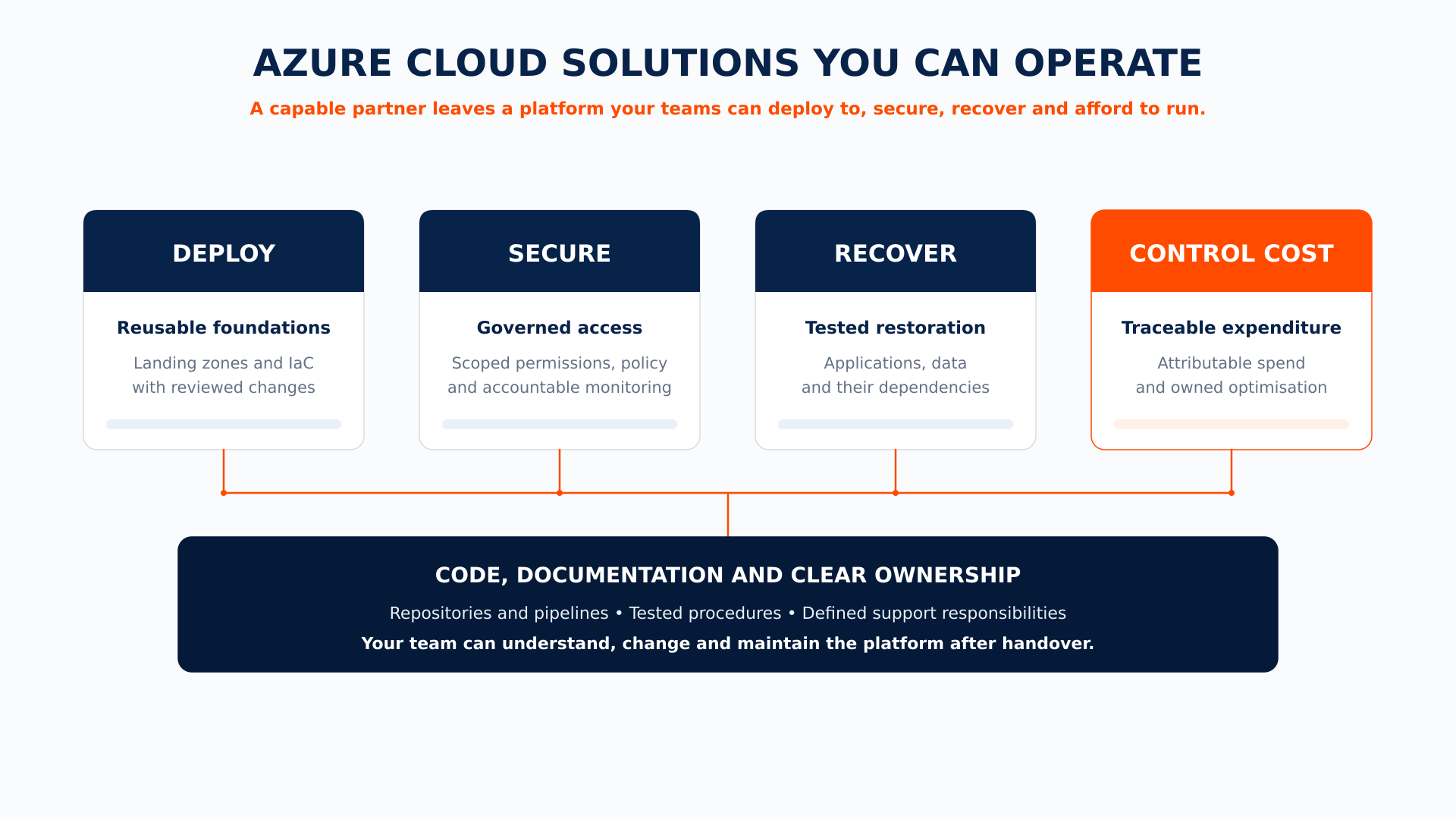
Azure cloud solutions should leave a UK business with a platform it can deploy to, secure, recover and afford to run. A capable partner delivers a landing zone, infrastructure as code, enforced security and governance, attributable costs, tested recovery and a defined support model, then hands over the code and documentation needed to operate them.
The engineering decisions made during an Azure migration, modernisation or expansion shape what your organisation can do next. They affect how quickly teams can deploy new services, how reliably applications run and how much work is required to keep the platform secure and under control.
An Azure partner should be able to explain those decisions in terms of your business services, then show how the resulting platform will be operated after delivery. The questions are practical: What will be built? How will changes be made? How will costs and risks be identified? What will your team be able to own and maintain?
The following areas provide a way to assess the answers. They also show where the engineering behind Azure cloud solutions makes a difference in production.
Azure consulting should start with outcomes and the operating model
Azure cloud solutions bring together infrastructure, managed services, data and application capabilities. Microsoft and its partners deliver these as cloud platform services, and the right combination depends on what each workload needs to deliver and who will be responsible for running it. A customer-facing service with demanding availability requirements calls for a different recovery approach from an internal reporting system that can tolerate a longer interruption.
Azure consulting should translate those requirements into a design. A useful proposal identifies the workloads in scope, their dependencies, the standards they will share and the decisions that remain specific to each application. It should also explain how the service will be monitored, changed and restored beyond the point of deployment.
For a critical application, ask what recovery would involve beyond restoring infrastructure. Data, identity, network connections and application components may have to return in a particular sequence. A partner should be able to show how it has accounted for those dependencies and how the complete recovery process will be tested.
Which Azure service model fits each workload?
The right model depends on which dependencies need infrastructure-level control and how much operational work the organisation wants to retain. Infrastructure as a service (IaaS), platform as a service (PaaS) and software as a service (SaaS) place different responsibilities with Microsoft, another provider and your own teams. The choice affects the maintenance you retain, the control you have and the options available for future change.
An application with a fixed operating system dependency may initially need virtual machines. Another workload may be suitable for managed hosting, containers or serverless services that reduce the infrastructure your team must maintain. SaaS may fit where an existing application meets the requirement without the organisation operating its underlying platform.
Ask the partner which dependencies genuinely require infrastructure-level control, which can be removed through modernisation and what operational work each proposed option leaves with you. The answer should come from assessment of the application and independent of any default preference for a particular Azure service. Where a virtual-machine move is the appropriate first step, the partner should be clear about whether it is the intended end state or a stage in a wider plan.
What is an Azure landing zone and what should a partner build?
An Azure landing zone is the shared foundation of management groups, subscriptions, policy, identity, networking and monitoring that workloads are deployed into. A partner should build it around the organisation's own structure and standards, then show how delivery teams will use it.
As more teams adopt Azure, they need a consistent way to deploy workloads without redesigning access, networking, monitoring and governance each time. Management groups can establish where policies apply, while subscriptions help define operational and cost boundaries.
Ask how the partner will design these foundations around your organisation. Which standards will apply across workloads? Where will teams have room to make application-specific choices? How will a new service be introduced, and who approves an exception to a shared control?
These questions have an operational consequence. When each project provisions its own resources and monitoring differently, the same fault can require a different investigation each time. Shared deployment patterns make the environment easier to understand and maintain as it grows. The partner should document those patterns and show how your delivery teams will use them.
How does a partner turn Azure capabilities into operational benefits?
Azure provides ways to scale applications, replicate data and integrate identity. A capable partner should explain the conditions under which those capabilities will improve your service, then design and test for the intended result.
For example, scaling can reduce the cost of spare capacity when resources increase and decrease with demand. Ask how scaling thresholds will be set, how performance will be measured and what happens when demand falls. A larger virtual machine that remains running after a busy period still generates charges.
The same test applies to resilience. Replication can make another copy of data available; it does not, by itself, prove that users can return to the application within the required time. Ask for a recovery plan covering the whole service and for evidence from an exercise that tested it. Where Microsoft Entra ID is used to simplify identity administration, ask how access will be assigned and reviewed. The benefit comes from the design and ongoing practice around each capability.
Why infrastructure as code should be standard in Azure delivery
Ask whether infrastructure as code is standard practice in the partner's delivery and what proportion of the proposed platform it will cover. Version-controlled definitions allow engineers to review changes before deployment, reuse approved modules and record intentional differences between development, test and production. Bicep or Terraform can provide the means to do this; the more revealing question is how the code is maintained and used once the platform is live.
Ask to see how a change moves from a request through review, deployment and verification. What happens if someone changes a setting directly during an incident? A firewall rule opened to restore service may remain in place afterwards. The partner should explain how it detects the resulting difference between the approved definition and the running environment, and how it resolves it. Where GitOps is proposed, ask what is continuously reconciled; a pipeline that deploys code does not automatically provide that behaviour.
Code also matters when a platform must be rebuilt. A known infrastructure definition gives recovery teams a repeatable starting point, but the application still needs its data and dependencies. Ask how the deployment code forms part of a tested restoration sequence and which code, repositories and pipelines your organisation will retain access to.
BlakYaks' Enterprise Azure Landing Zone Accelerator Pack uses pre-engineered infrastructure as code and deployment pipelines to establish these foundations. Its handover includes design documentation and infrastructure as code modules so the receiving team has a basis for operating and changing the platform.
What security and governance should an Azure partner provide?
An Azure partner should show how people and workloads receive the access they need, how deployment rules are enforced and how exceptions are managed. These decisions should be built into the design and the delivery process from the start.
Ask how the partner will scope permissions in Microsoft Entra ID, including access for managed identities and service principals. A proof of concept that relies on a service principal with broad subscription-level access can be difficult to tighten later if nobody has recorded which permissions the application needs. The partner should establish suitable boundaries during design and demonstrate how access will be reviewed.
Azure Policy can report, prevent or help remediate configurations within its supported scope. Ask which policies will apply to your workloads, where they will be assigned and how exceptions will be approved, owned and reviewed. A restriction on public access, for instance, needs to cover the relevant services and deployment scopes to achieve the intended control.
Monitoring should lead to action. Microsoft Defender for Cloud can surface security posture findings, while Microsoft Sentinel can support investigation using the telemetry configured for collection. Establish who assesses findings, who makes changes and how remediation is verified. Compliance dashboards and deployment records may contribute evidence, but your organisation still needs to assess whether the controls meet its requirements and whether any manual evidence is needed.
For UK organisations with data residency commitments, ask for a service-by-service assessment. Selecting a UK Azure region does not settle every question about where data is stored or processed. The partner should account for the services and deployment types used, replication arrangements and applicable contractual terms.
Azure migration: rehost, modernise or hybrid?
The right approach depends on the application, its dependencies and the timeframe. Moving an application to Azure can meet an immediate requirement, such as leaving a data centre, while retaining much of its existing patching and operating workload. Modernisation changes how the application is built or run. Both approaches can be appropriate.
Before recommending a destination, a partner should assess application dependencies, availability needs, security requirements and the work involved in operating the proposed design. Ask which workloads can move largely as they are, which would benefit from managed services, and what evidence supports each decision. If a hybrid connection to on-premises systems are needed, establish whether it is transitional or an enduring part of the operating model.
The migration plan should also cover testing, cutover, rollback and responsibility after go-live. It should explain what must be true for a workload to be considered ready and how its performance, cost and recoverability will be assessed once it is in Azure. BlakYaks' Azure Migration Framework for Enterprise uses discovery and assessment to guide these choices.
How should an Azure partner build in cost control?
An Azure partner should be able to show how the platform it designs and operates will help your organisation understand and control spend. Commercial discounts can lower the price of consumption; decisions about architecture, resource sizing and operating schedules determine how much is consumed.
Ask how the partner will identify unused capacity and test whether resources match measured demand. A non-production environment may be able to shut down overnight, while an oversized database may be reduced without affecting the service it supports. Recommendations should account for performance and resilience requirements, with an owner responsible for approving and implementing each change.
Cost also needs to be attributable. Ask how subscriptions and supported tags will connect charges to workloads and teams, and how shared services will be allocated. Once spending can be traced, engineers can investigate changes in consumption, assess resizing opportunities and decide whether predictable workloads justify reservations. The partner should be able to explain the expected benefit, the assumptions behind it and how the outcome will be checked after the change.
What should Azure managed services include?
Managed services can cover incident response, routine operations and planned improvement, but their scope varies. Before agreeing a service, establish the coverage hours, responsibilities, escalation routes, reporting and recovery commitments that your applications require. The agreement should also state which cloud platform services, such as monitoring, backup and patching, the provider operates and which remain with your teams.
Ask what happens after a monitoring alert or security recommendation appears. Who investigates it, who decides on the response, who implements the change and who verifies the result? A report of rising consumption is more useful when the provider can explain the cause and carry an agreed correction through to completion. Recovery procedures deserve the same scrutiny: ask when the whole service was last exercised and what the test showed.
Establish how your team will work with the provider, too. Repository ownership, access to deployment pipelines, documentation and knowledge transfer affect your ability to understand and maintain the platform. Ongoing support should leave a clear record of what has changed and which improvements remain to be made.
BlakYaks' Specialist Operations (SpecOps) brings together ITIL and SRE practices with engineering changes delivered through code. Its model can combine day-to-day operational cover with additional capacity for planned improvement; specific service and recovery commitments are agreed for each engagement.
How should AI workloads follow the same Azure platform standards?
AI services need access to data, applications and sometimes tools that can take action in other systems. A partner should explain how each AI workload will be deployed, governed, observed and supported within your wider Azure environment. Reusing established platform controls can make those decisions more consistent as the number of use cases grows.
Ask how identities and permissions will limit what an application or agent can reach. Where private endpoints are proposed, establish which network paths they protect and what other configuration is required. Assess processing location separately: it depends on the service, model deployment type and relevant terms, as described in Microsoft's data-processing guidance.
Production support requires visibility across the full application flow. If a request fails, can engineers tell whether the cause was authentication, the model response or a downstream system? Ask what will be logged, how sensitive information in logs will be handled and who will respond to findings. For agents, review the actions their connected tools permit as carefully as access to the underlying data.
BlakYaks' AI Foundations Accelerator Pack provides pre-engineered deployment foundations and integrated access controls, with networking and monitoring capabilities to support enterprise operation.
Azure partner credentials: what Solutions Partner designations and specialisations show
Credentials show where a partner has been assessed by Microsoft. Design decisions and delivery evidence show how that expertise will be applied in your environment.
Microsoft Solutions Partner designations and Azure specialisations can provide evidence of a partner's skills and performance in relevant areas. Ask which credentials relate to your proposed engagement and how the people assigned to your project have applied that expertise. Credentials are a useful starting point for due diligence.
Ask the partner to walk through a relevant deployment module, a documented design decision or a realistic failure scenario. For example, a policy applied at management group level may affect several subscriptions. An experienced team should be able to explain where the policy belongs, how an exception would work and what the wider consequences could be. Microsoft publishes the requirements for its specialisations on its partner programme pages.
Questions to ask before choosing an Azure consulting partner
Use the proposal and technical discussions to establish what you will receive:
Which workloads and dependencies have you assessed, and what evidence supports the proposed destination for each one?
What parts of the platform will be defined in code? Can we review the modules, change process and documentation?
How will identity, policy exceptions, monitoring and recovery work across new workloads?
How will costs be attributed, investigated and improved after deployment?
Who will own the repositories, retain pipeline access and operate the platform after handover?
What is included in ongoing support, and who is responsible for acting on operational findings?
What has the last full-service recovery exercise demonstrated for a comparable service?
The answers should connect the proposed architecture with the way your teams will deliver and operate services. Ask to see evidence where the answer depends on an existing process or capability.
Judge the solution by what remains after delivery
A successful Azure engagement should leave your organisation with more than a deployed set of services. It should provide a platform your teams can understand, change and recover, with clear ownership and an operating model that can keep pace as new workloads are added.
Review the proposal against those outcomes. Maintained code, usable documentation, tested procedures and accountable support provide a stronger basis for long-term value than a list of Azure services alone.
If you already operate in Azure and need an informed starting point, BlakYaks' Azure Vitals Assessment reviews the current Azure environment and provides prioritised findings and recommended next steps. It gives your team evidence for deciding where to focus improvement.
Key takeaways
Ask for a design that maps each workload to its availability, recovery and ownership requirements, and shows how the service will be monitored, changed and restored after go-live.
Expect a reasoned choice between IaaS, PaaS and SaaS for each application, including whether a virtual-machine move is an end state or a stage.
Look for an Azure landing zone and shared deployment patterns that new workloads can reuse.
Check that infrastructure as code covers the platform, that drift from the approved definition is detected and that your organisation retains the repositories and pipelines.
Require scoped identity permissions, Azure Policy with owned exceptions and a named owner for every security finding.
Ask for a service-by-service data residency assessment. Selecting a UK Azure region does not settle where all data is stored or processed.
Look for cost attribution through subscriptions and tags, with an owner for each optimisation.
Establish what managed services cover: hours, escalation, reporting, recovery commitments and who acts on findings.
Request evidence of a full-service recovery exercise for a comparable workload.
Frequently asked questions
What is an Azure landing zone?
An Azure landing zone is the shared foundation that workloads are deployed into. It combines management groups, subscriptions, policy, identity, networking and monitoring so that each new workload inherits consistent controls instead of redesigning them. Microsoft describes the approach in its Cloud Adoption Framework.
Does a UK Azure region guarantee UK data residency?
Selecting a UK region such as UK South or UK West does not settle every question about where data is stored or processed. The answer depends on the services used, their deployment types, replication arrangements and the applicable contractual terms, so a service-by-service assessment is needed.
What is the difference between Azure Policy and Microsoft Defender for Cloud?
Azure Policy evaluates resource configurations against defined rules and can report, prevent or help remediate them within its supported scope. Microsoft Defender for Cloud surfaces security posture findings and recommendations. Both need named owners to act on what they report.
Is infrastructure as code enough to recover an Azure platform?
Infrastructure as code gives recovery teams a repeatable definition of the platform. The application still needs its data, identity and dependencies restored in the right sequence, so the code should form part of a restoration process that has been tested for the whole service.
What should an Azure managed services agreement cover?
The agreement should state coverage hours, responsibilities, escalation routes, reporting and recovery commitments. It should also say who investigates alerts and security recommendations, who implements changes, who verifies the result and which repositories, pipelines and documentation your organisation retains.
How should an Azure partner approach cost control?
Cost control starts with architecture, resource sizing and operating schedules. A partner should connect charges to workloads and teams through subscriptions and tags, give each optimisation an owner and check the outcome after the change, including whether reservations suit predictable workloads.