
Summary: AI pilots can prove that a model and use case work. Production readiness depends on whether the Azure platform can deploy, govern and operate the service consistently. This article sets out five practical tests covering repeatable deployment, governed identity, embedded governance, end-to-end operational visibility and the platform operating model.
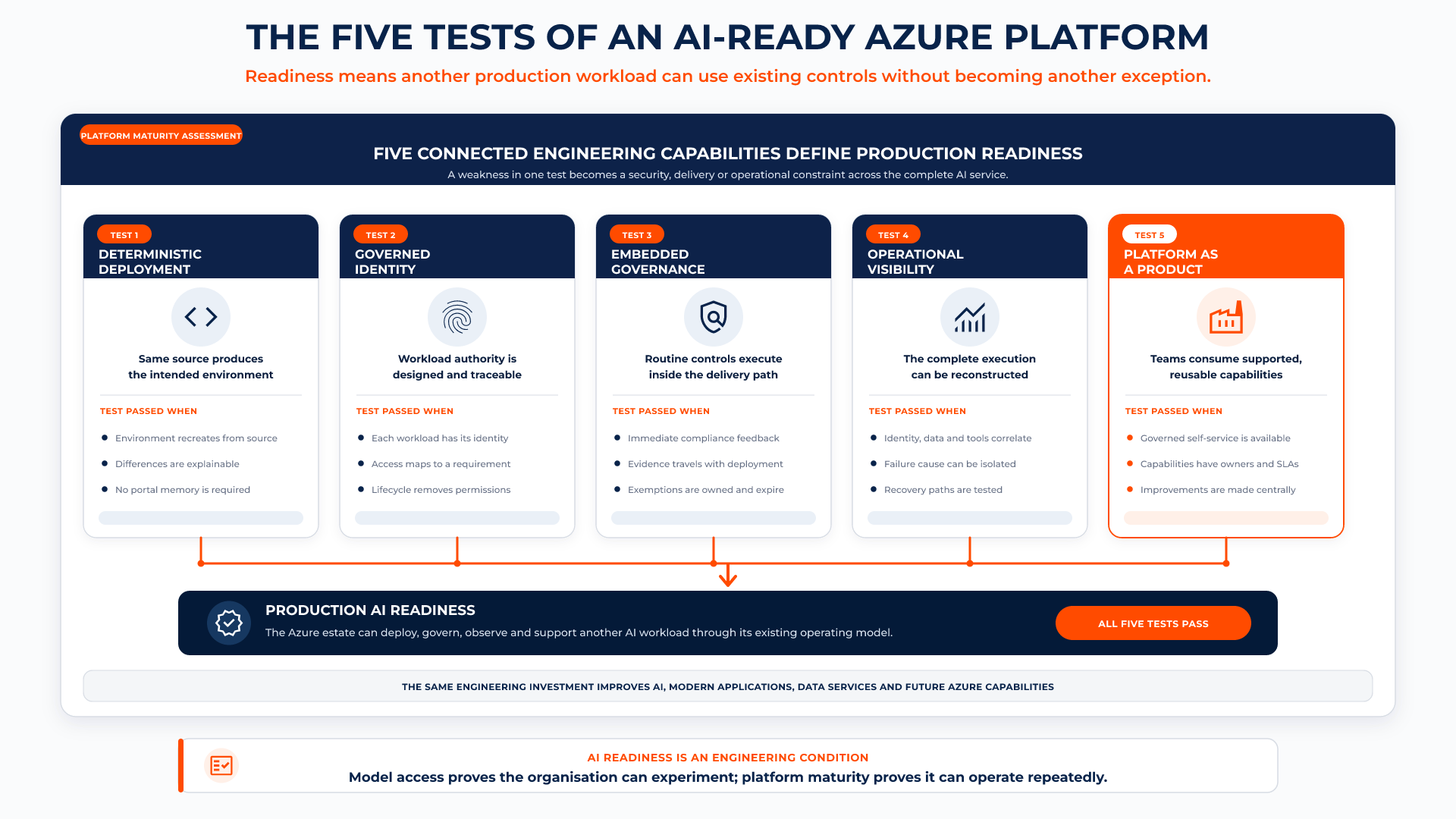
Five interconnected engineering capabilities that determine whether an Azure platform can securely deploy, govern and operate AI workloads at scale.
A proof of concept can succeed with manually created resources, broad development permissions and public end points. Production is different. The workload must run inside the enterprise Azure estate, use approved identity and connectivity, satisfy policy requirements, and be supported through normal operations.
Most production AI workloads depend on several services: model deployment, search, storage, secrets management, an application runtime and internal APIs. Weakness in any one layer can stop the service or increase operational risk.
At BlakYaks, we assess AI readiness by testing whether these dependencies can use established platform capabilities. A platform is mature when AI demand can grow without manual provisioning, recurring security exceptions or support effort rising at the same rate.
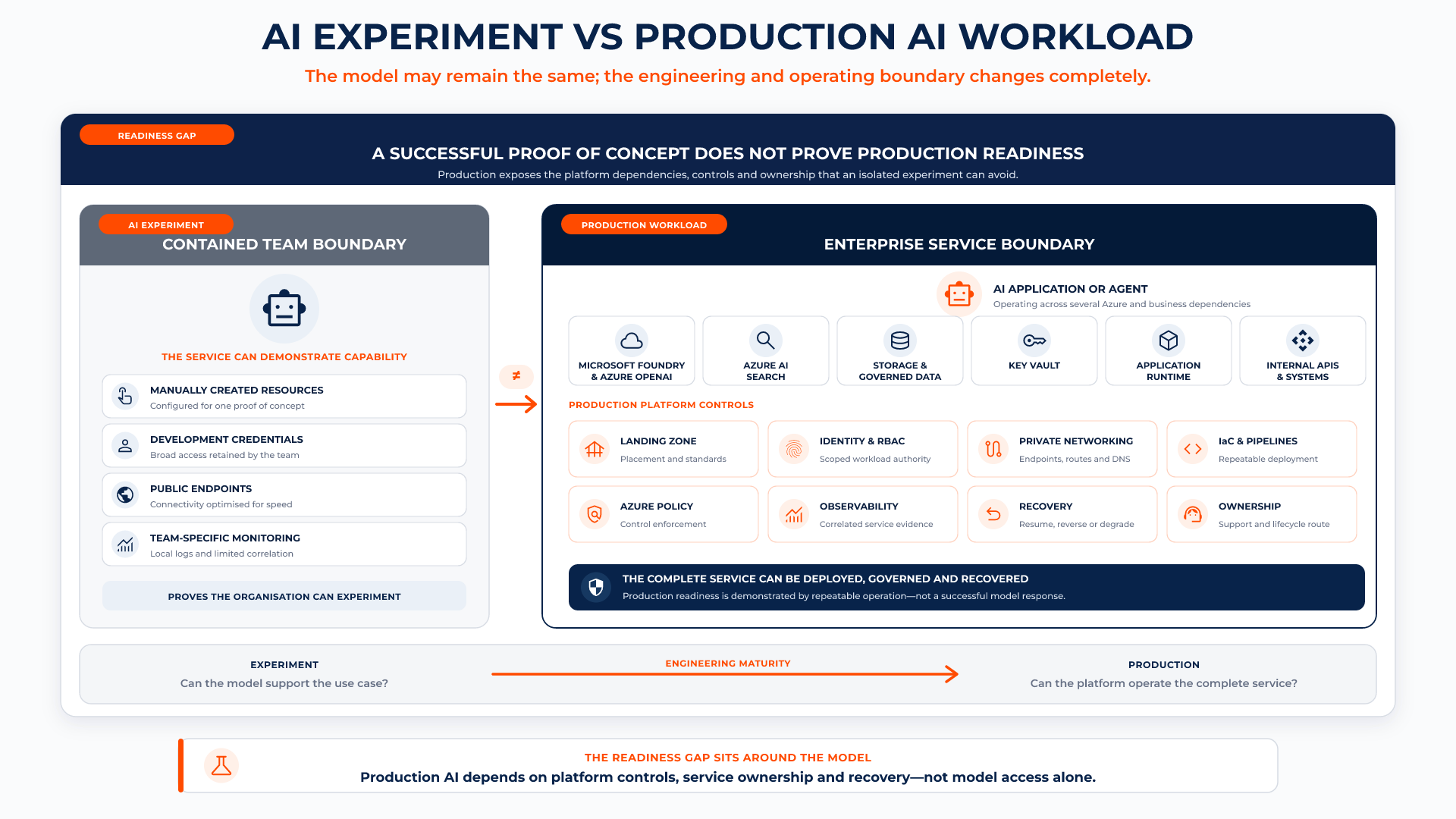
A successful AI pilot proves feasibility, not production readiness. Scaling AI requires secure connectivity, governed identities, operational visibility and reliable recovery across the complete service.
Test one: deployment is repeatable
A mature platform can recreate the intended environment from an approved source. Infrastructure as Code(IaC) defines landing zones, networking, policy, identity and workload resources, while controlled pipelines apply those definitions consistently across development, test and production.
Portal changes are a warning sign. An engineer can add a route, role assignment or diagnostic setting quickly, but unless that change is returned to source control, the live environment becomes the only record. Environments then drift, releases become less predictable and recovery depends on individual memory.
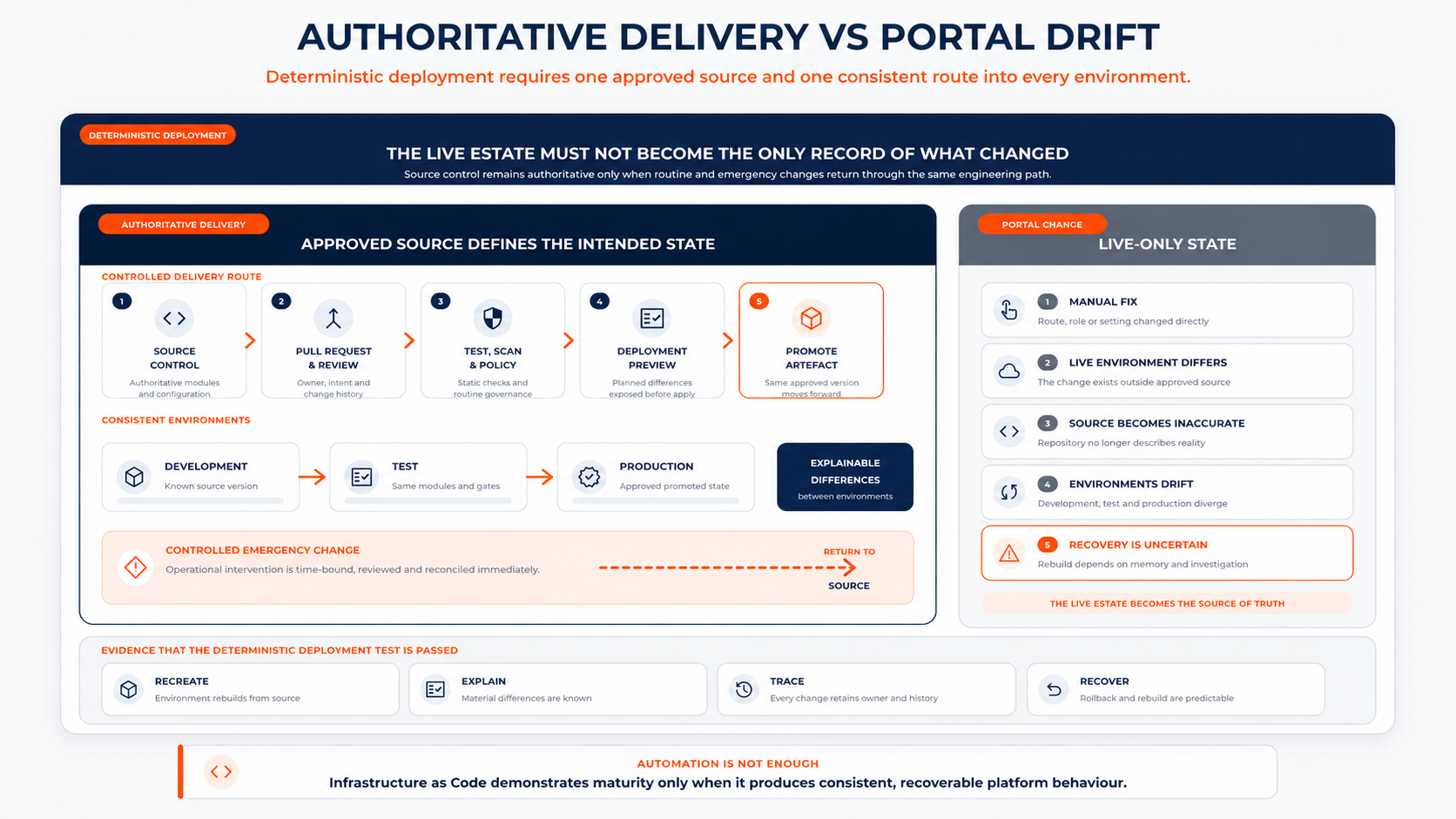
Consistent Azure deployments depend on approved source control. Untracked manual changes introduce configuration drift, increasing operational risk and making recovery less predictable.
IaC alone does not guarantee consistency. If teams maintain different Terraform or Bicep modules, pin versions inconsistently, or run different pipeline checks, automation reproduces multiple standards. Equivalent workloads can then receive different network, policy and monitoring controls.
Maintained modules, deliberate versioning and one controlled route to production reduce that variation. Material changes should receive accountable review, supported by automated analysis, security scanning, deployment previews and Azure Policy evaluation. Emergency changes should also be reconciled back to source control.
▶ Repeatability is visible when teams can recreate environments from source control, explain material differences between tiers and deploy additional AI workloads without relying on manual portal configuration.
Test two: identity is governed by design
Production AI workloads retrieve data, invoke models, call APIs and may update systems of record. Identity therefore belongs in platform architecture alongside networking and policy. Managed identities should be used where supported, with Azure role-based access control and application permissions limited to the workload's approved purpose.
Identity debt often starts with a shortcut: one service principal gains more roles as integrations increase, becomes shared across components, and loses clear ownership. Secrets require rotation, unused permissions persist, and risk grows over time.
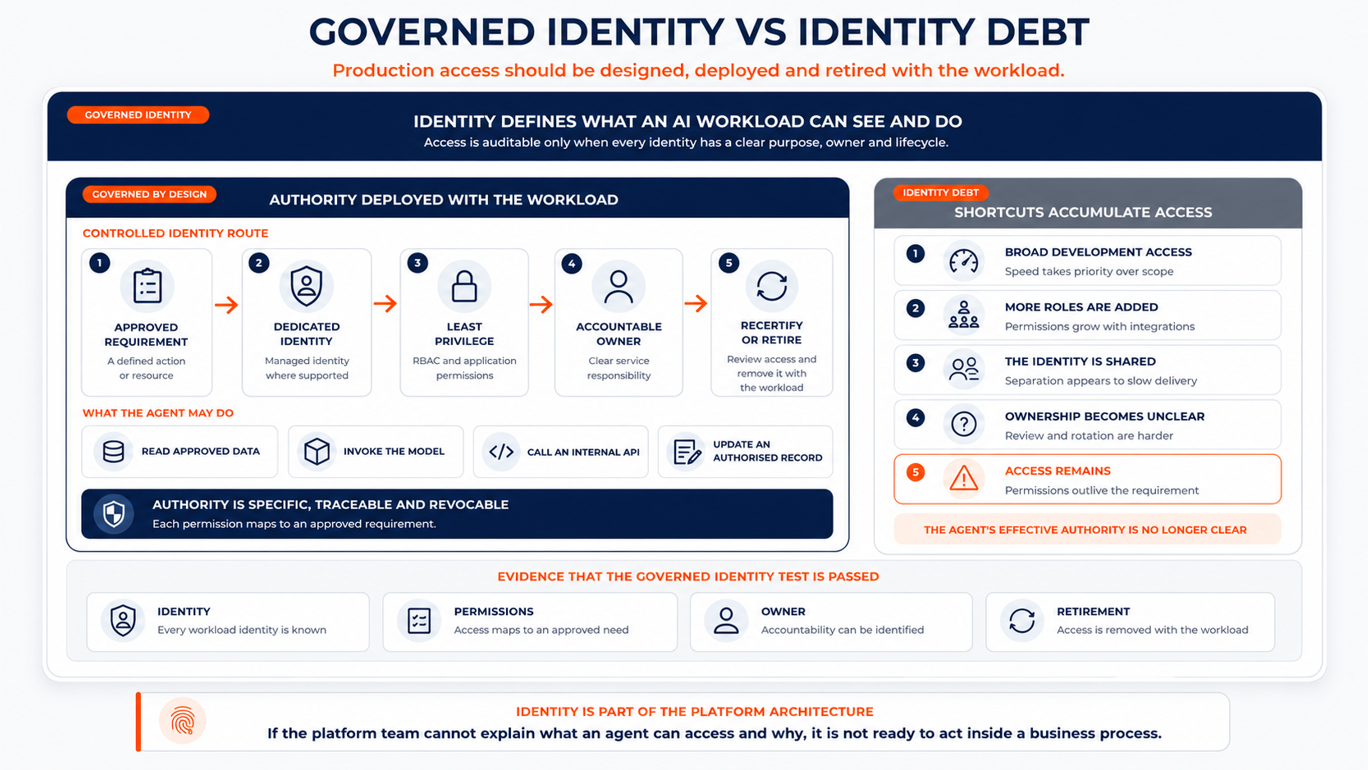
AI workloads need identities and permissions designed around approved business requirements. Without clear ownership, least-privilege access and regular reviews, permissions accumulate, increasing security risks and making accountability harder.
Broad development permissions should not move into production. An agent that classifies service requests might need read access to approved data and permission to write a routing decision. It does not need Contributor rights across a subscription. Where workflows perform distinct actions, separate identities improve accountability and limit blast radius.
A mature platform deploys identity with the workload. IaC creates managed identities, role assignments and access paths to protected services, and records accountable ownership metadata. Permissions can then be reviewed, recertified and removed centrally when requirements change.
▶ A production AI workload is ready when its identities, permissions and accountable owner are easy to identifyand review, and each permission maps to an approved business requirement.
Test three: governance is built into delivery
Governance scales when routine controls run in delivery pipelines. Azure Policy can audit or enforce requirements such as approved regions, network exposure, diagnostic settings and resource configuration. Pipelines can test IaC, check for secrets and block unapproved changes before production.
Manual governance produces uneven results. One subscription may deny public access while another keeps the same requirement only in a design document. Policy initiatives diverge between management groups, exemptions remain open, and teams discover requirements late.
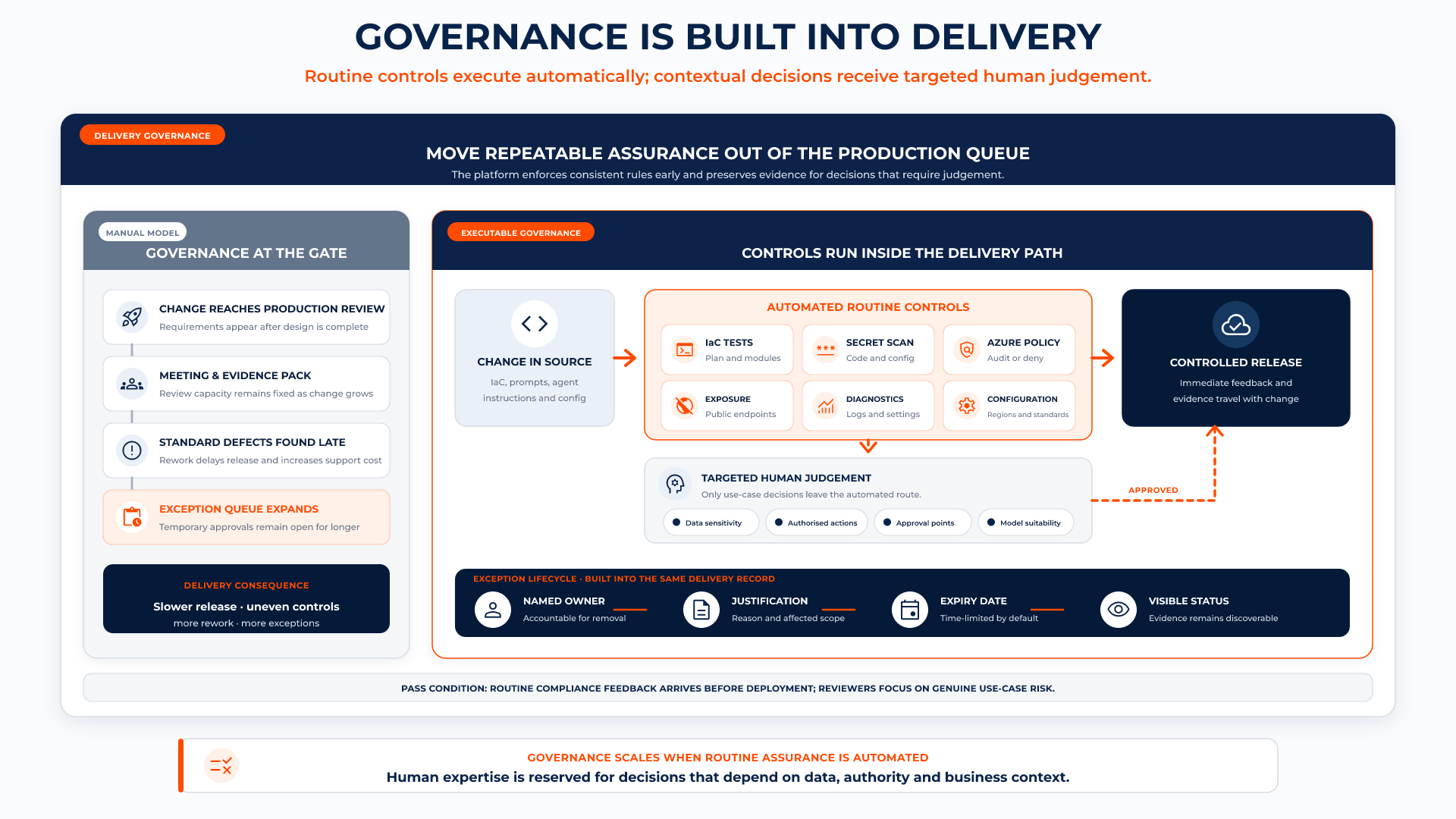
Embedding automated security and compliance checks into delivery pipelines reduces bottlenecks, enforces consistent standards and allows human expertise to focus on higher-risk decisions.
AI increases the pace and range of change: prompts, agent instructions, model deployments, data connections and supporting infrastructure evolve continually. If each iteration requires manual evidence collation or gate meetings, governance becomes a delivery bottleneck.
Automation cannot make every governance decision. Data sensitivity, authorised actions, human approval points and model suitability still depend on context. The platform should automate controls that apply consistently, and record evidence for decisions that require human judgement. Exemptions should be time-limited, owned and visible.
▶ Teams should receive compliance feedback before deployment, while pipelines record required checks and approvals. If experienced reviewers still find standard configuration defects at the final gate, governance will not scale.
Test four: visibility covers the complete service
Resource availability shows whether services are running; it does not show whether an AI workflow completed correctly. Operations teams need a correlated view across application traces, model activity, identity events, data access, downstream calls and deployment history.
In fragmented Azure estates, comparable services often send diagnostics to different workspaces, retain data for different periods and use inconsistent alert severities. During incidents, teams first have to find telemetry and decode how the workload was instrumented.
What complete operational visibility looks like across an AI service (incident reconstruction):
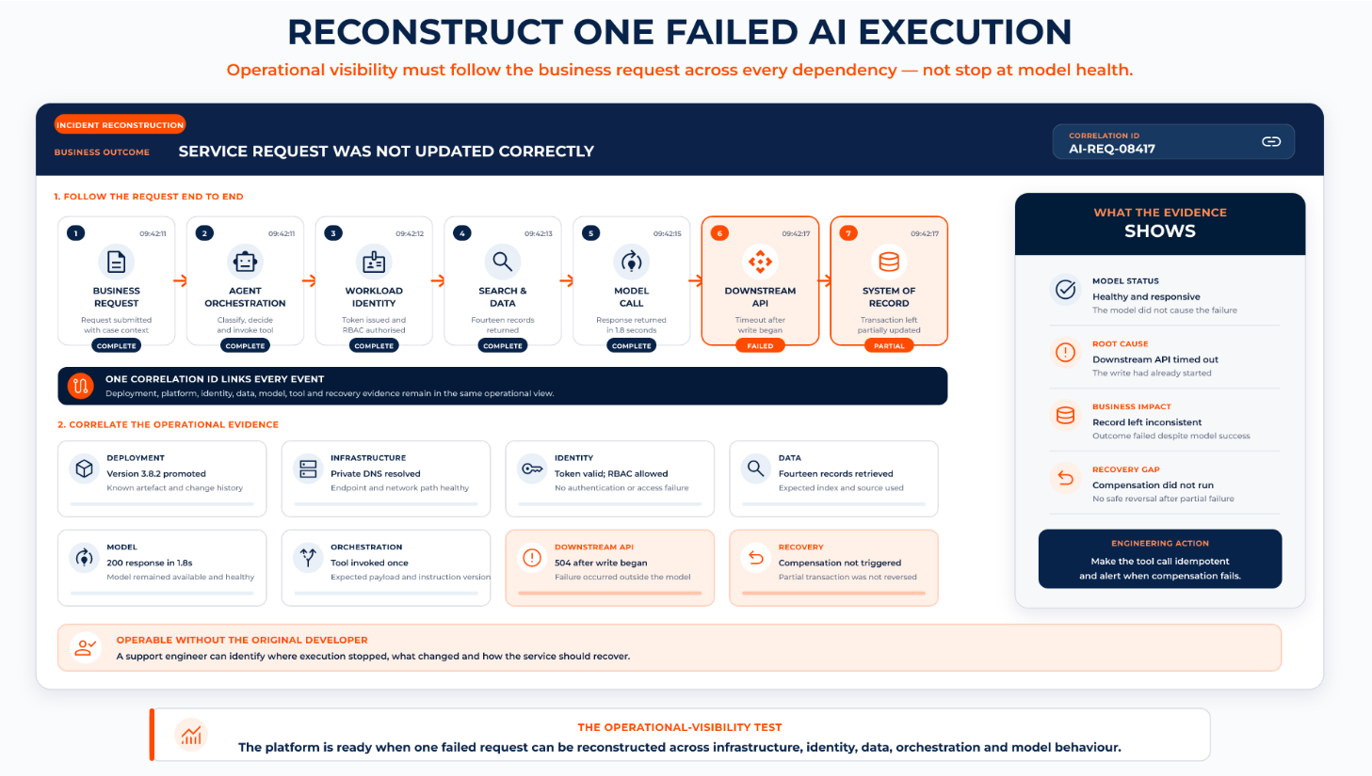
A healthy AI model does not guarantee a successful business outcome. End-to-end operational visibility enables teams to trace failures across infrastructure, identity, data, models and downstream systems, identify root causes and recover services effectively.
A failed business outcome can have several causes. The model may be healthy while identity access fails, private DNS misroutes traffic, search returns incomplete data, or a downstream API partially completes a transaction. Model-quality checks alone will not isolate those faults.
Observability should ship with the workload. IaC can apply diagnostic settings, correlation standards, retention policies and alerting. Azure Monitor, Application Insights and Log Analytics can then provide a common operational view, supplemented with security and identity logs where needed.
▶ During incidents, engineers should be able to reconstruct failed execution, identify where flow stopped, and separate infrastructure, identity, data, orchestration and model behaviour without depending on the original developer.
Test five: the platform works as a product
A platform product gives delivery teams supported capabilities they can discover and consume. Landing zones, network patterns, identity, model access, deployment pipelines and observability are maintained as services with owners, versions, documentation and a managed backlog.
Many central platform teams still operate project by project. Each workload raises tickets for environments, connectivity, access, pipelines and monitoring. Similar infrastructure is rebuilt repeatedly, but small variations prevent reuse.
AI demand makes this model expensive. Business units often identify many smaller use cases, each requiring the same foundations. If each initiative receives a separately designed environment, operational complexity rises with workload volume.
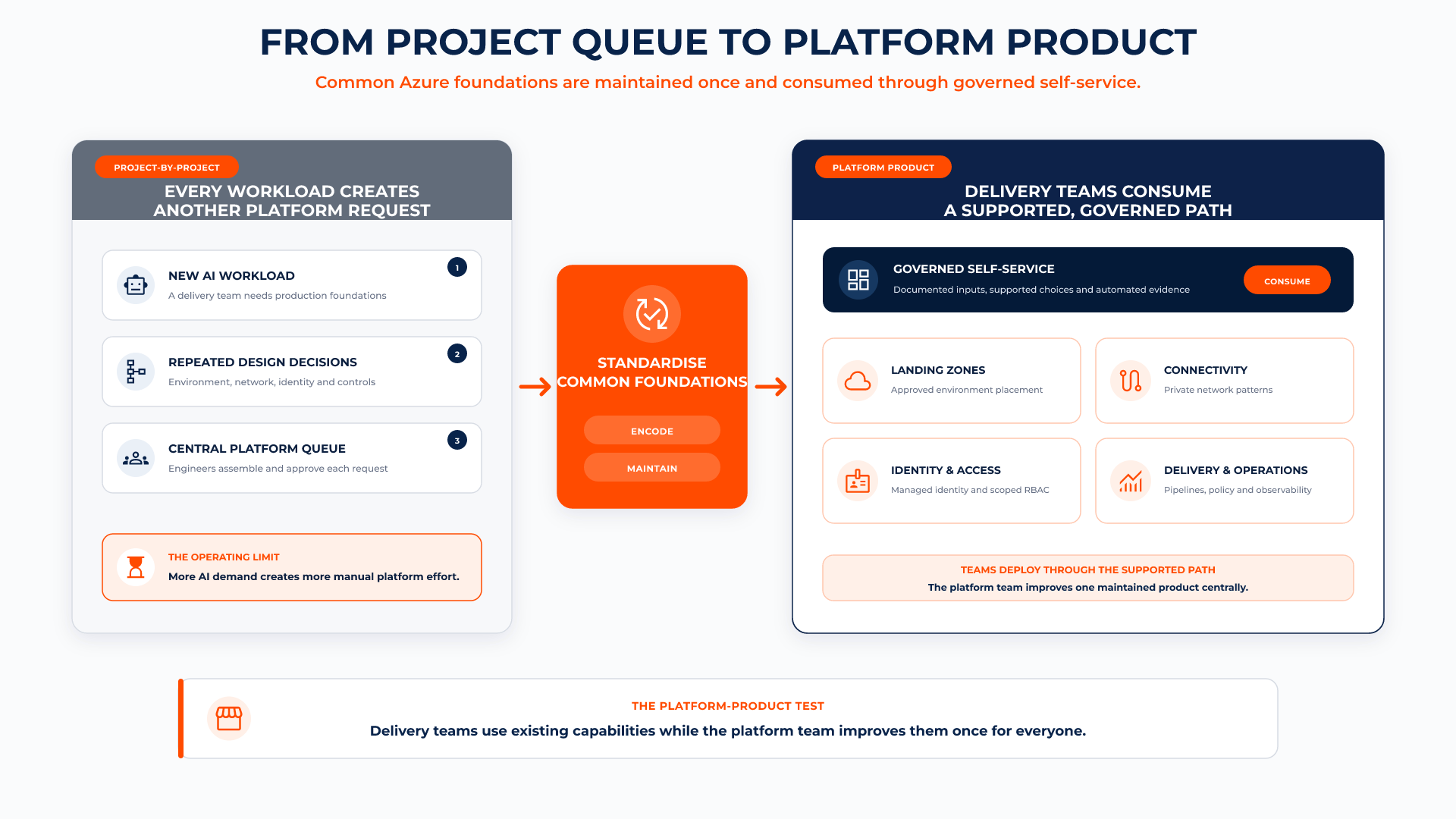
Reusable, governed Azure foundations reduce repeated engineering effort, enabling teams to deploy AI workloads faster while maintaining consistent security, control and operational standards.
Product discipline matters as much as technical components. Platform teams should publish supported routes, measure adoption and reliability, manage breaking changes and retire outdated patterns. Delivery teams also need a clear route to request genuinely new capabilities without turning every implementation into an exception.
▶ Delivery teams should be able to deploy governed AI workloads using existing platform capabilities, while platform teams improve those capabilities centrally.
Use the five tests as one assessment
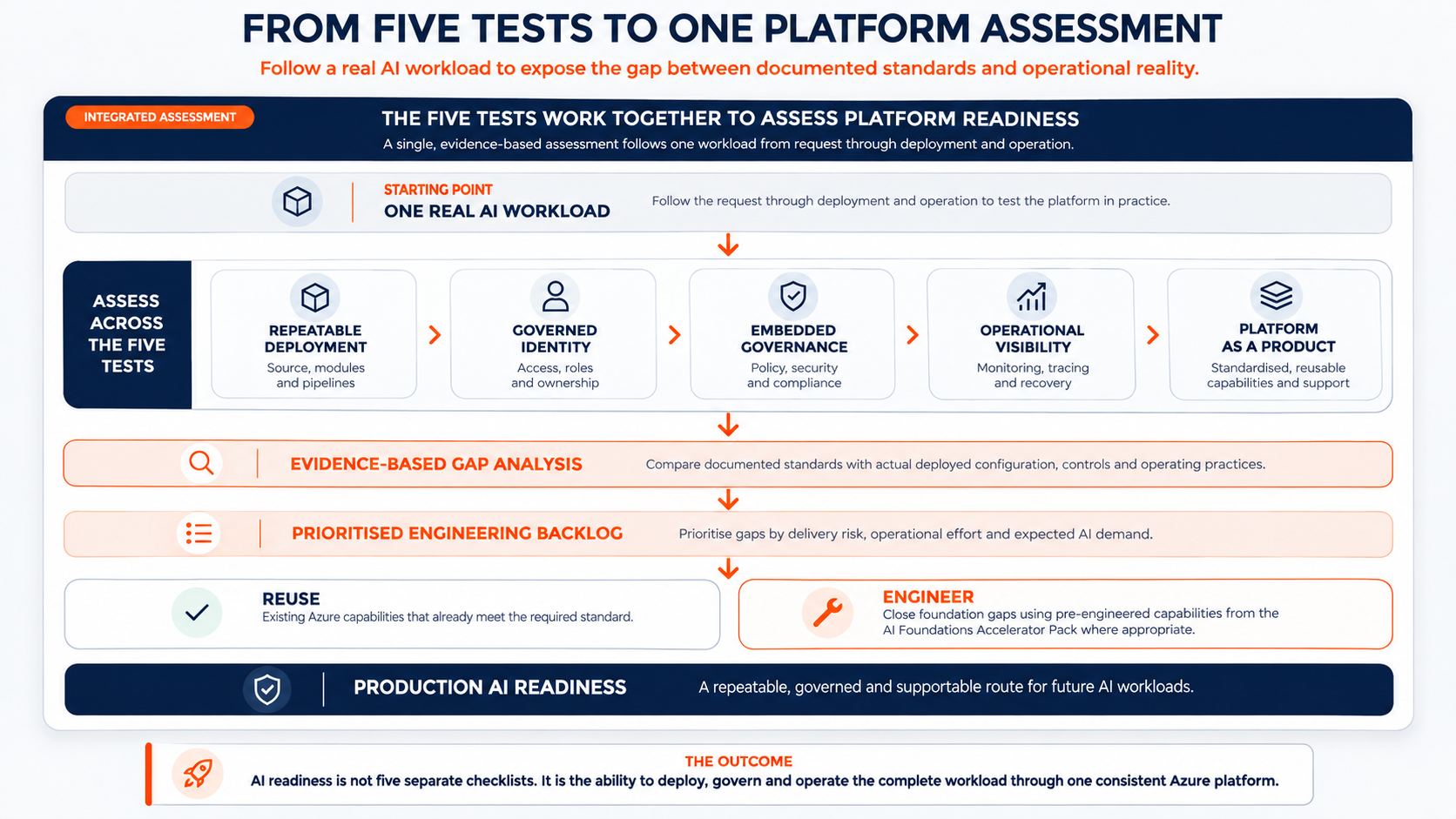
These five tests are interdependent. Repeatable deployment remains insecure if identities are assigned manually. Operations teams cannot reconstruct incidents if deployed configuration differs from source control. Governed self-service depends on consistent controls across landing zones and workloads.
A useful assessment follows a real workload from request through deployment and operation. Repositories, pipelines, identity permissions, policy controls and support ownership reveal the gap between documented standards and live operation. The outcome should be a prioritised engineering backlog linked to delivery risk, operational effort and expected AI demand.
BlakYaks' Azure platform and AI foundations assessments use this evidence to identify what can be reused and what must change. Where foundations are missing or inconsistent, the AI Foundations Accelerator Pack provides pre-engineered capabilities for identity, private connectivity, IaC, policy, deployment and observability.
Questions for senior technology leaders
A practical readiness review should ask:
Can the platform recreate an AI environment from source control without manual production changes?
Does each workload use a governed identity with permissions linked to approved business requirements?
Are common security and compliance controls executed automatically during deployment across relevant landing zones?
Can operations teams trace a failed request across identity, data, models, tools and downstream services?
Do delivery teams use maintained platform capabilities, or request new infrastructure for each workload?
If AI workload demand increased substantially, would manual review and support effort rise at the same rate?
Platform maturity is the practical test of AI readiness
AI readiness is visible when the Azure platform can absorb increased production change without weakening repeatability, least-privilege access, policy enforcement, operational evidence or supportability. The five tests expose where this is already true and where engineering work still remains.
→ A practical next step
Is your Azure platform ready to support AI at scale? BlakYaks can help you assess your existing foundations, identify engineering gaps and prioritise improvements to enable secure, repeatable AI deployment. Speak to our team to explore an Azure Platform or AI Foundations Assessment.