
Accelerating AI without losing control
In Part 1 of our reflections on our event ‘Driving Azure Performance and Scale Under Pressure’ at Mercedes-Benz World, we explored the themes emerging from Richard West's keynote, Microsoft's vision for the Frontier Firm and the practical lessons shared by our customer panel.
The morning concluded with a session from Stuart Anderson, Chief Technology Officer at BlakYaks, who looked ahead to the next challenge facing technology leaders: how to accelerate AI adoption without losing control.
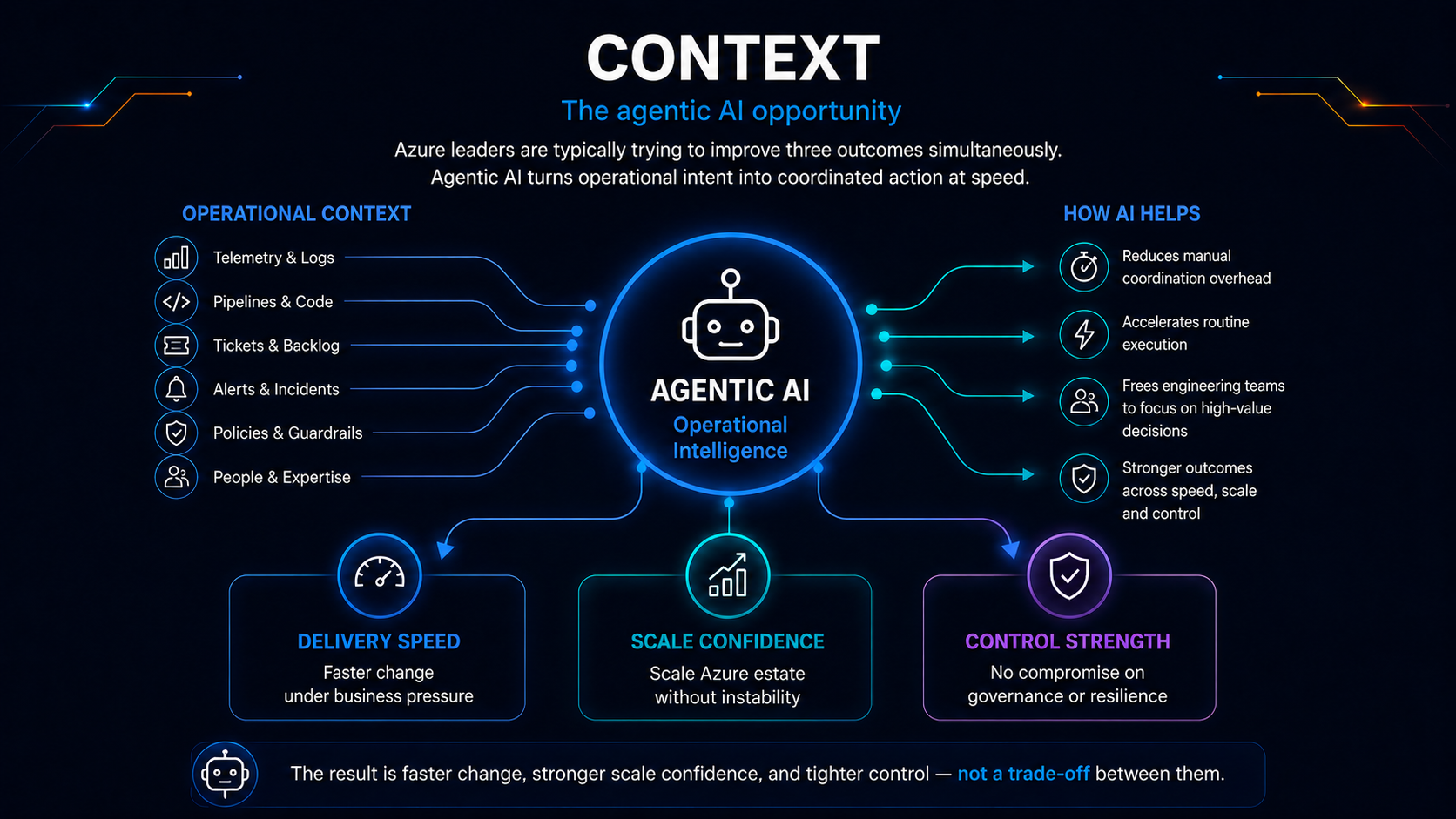
His session explored how agentic AI could reshape DevOps, engineering and cloud operations, focusing on three outcomes Azure leaders are increasingly trying to improve simultaneously:
Delivery speed.
Scale confidence.
Control strength
Agentic AI has the potential to help organisations improve all three.
By turning operational intent into coordinated action, agents could reduce manual coordination, accelerate routine execution and allow experienced engineers to focus more of their time on higher-value decisions. The session positioned these three outcomes as complementary rather than a trade-off.
Autonomy is not binary
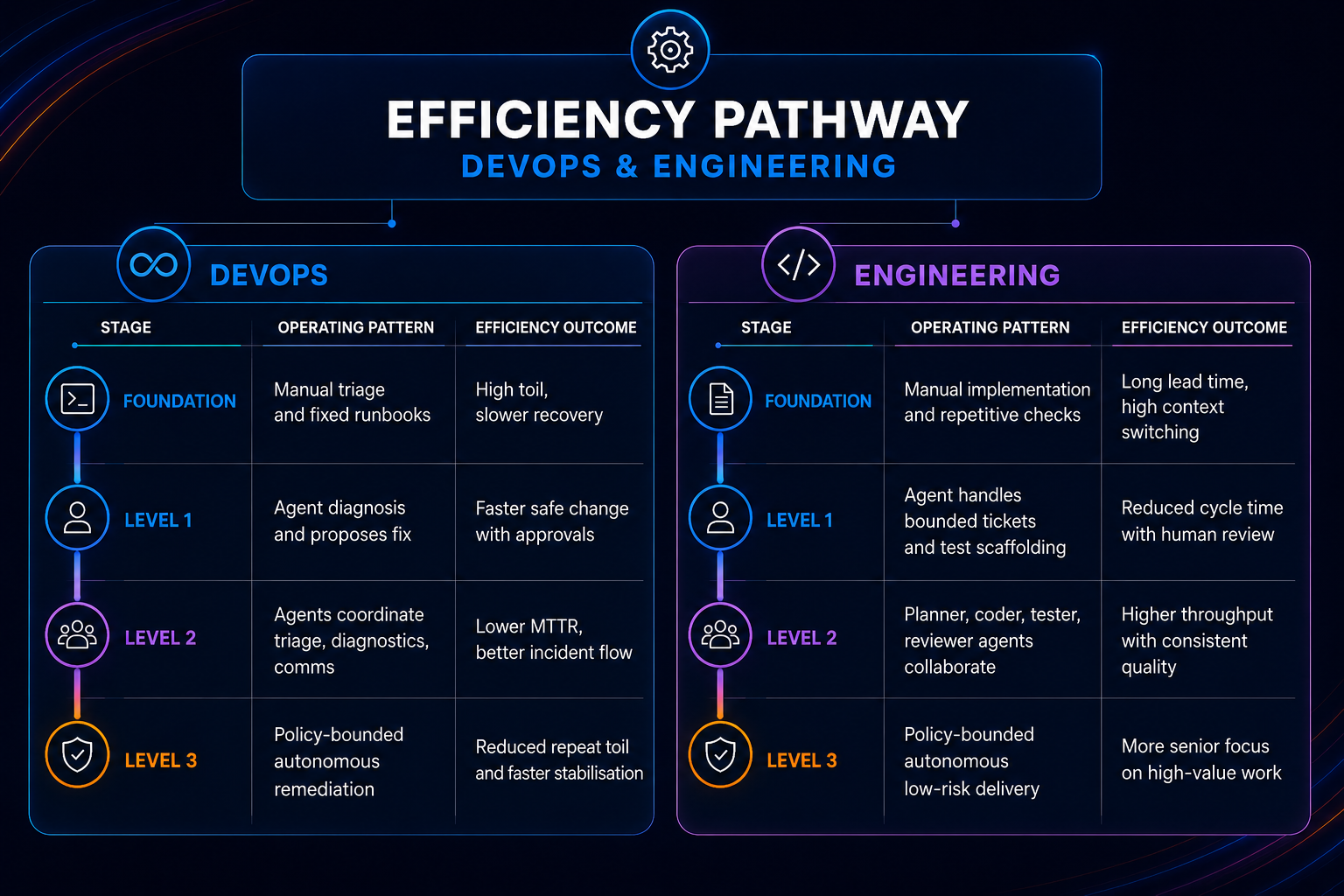
Stuart introduced a practical AI autonomy maturity model, progressing from deterministic scripts and workflows, through tool-using assistants and orchestrated multi-agent systems, towards goal-driven autonomous operators working within bounded authority.
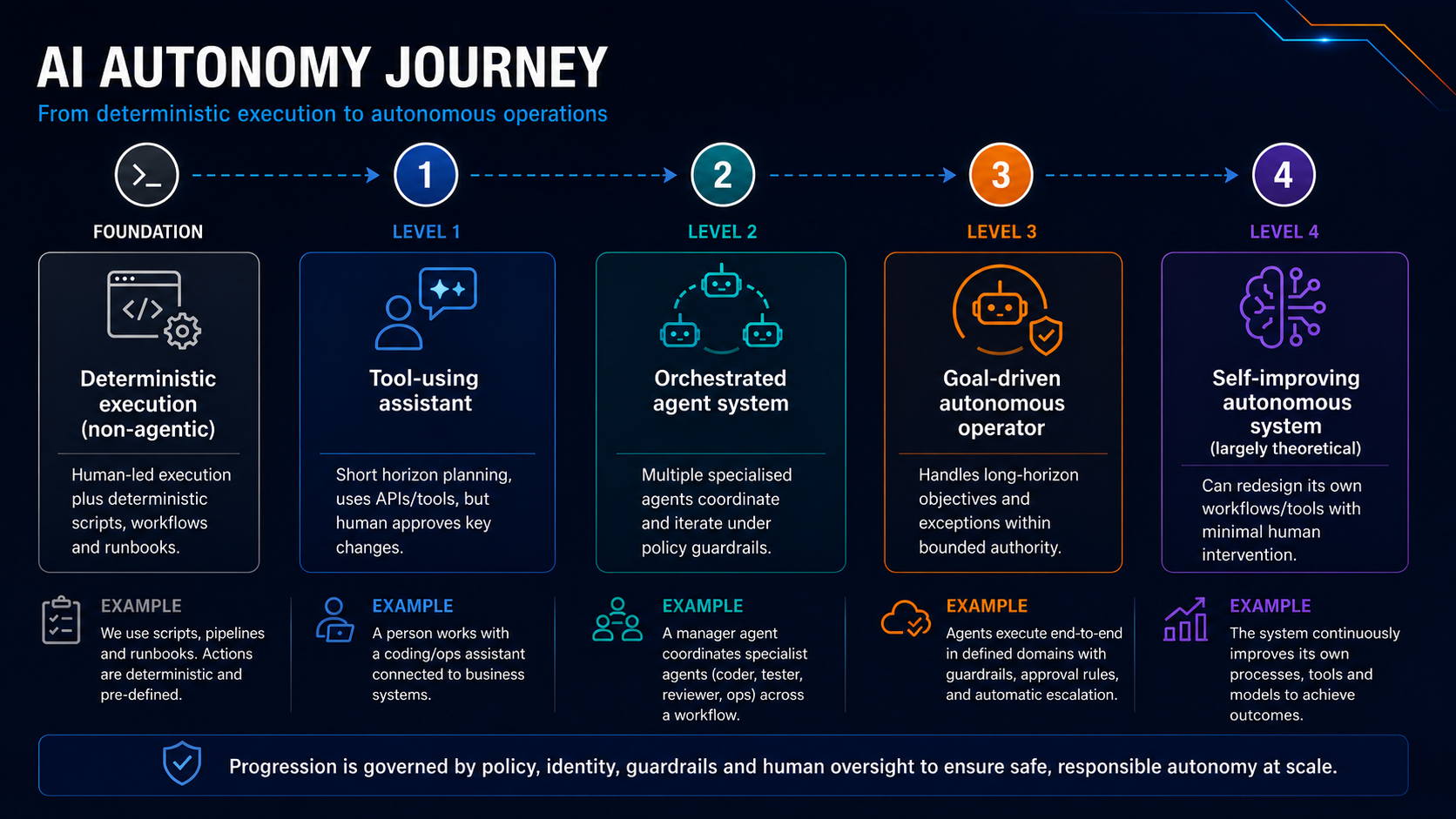
The operational opportunities are significant. In DevOps, agents could support incident diagnosis, coordinate triage and communications, and eventually perform policy-bounded remediation.
Within engineering, specialist agents could collaborate across planning, coding, testing and review, reducing repetitive work and allowing senior engineers to focus on more complex problems.
But the real efficiency gains only appear when four elements are connected in a governed operating loop:
Detect. Decide. Execute. Learn.
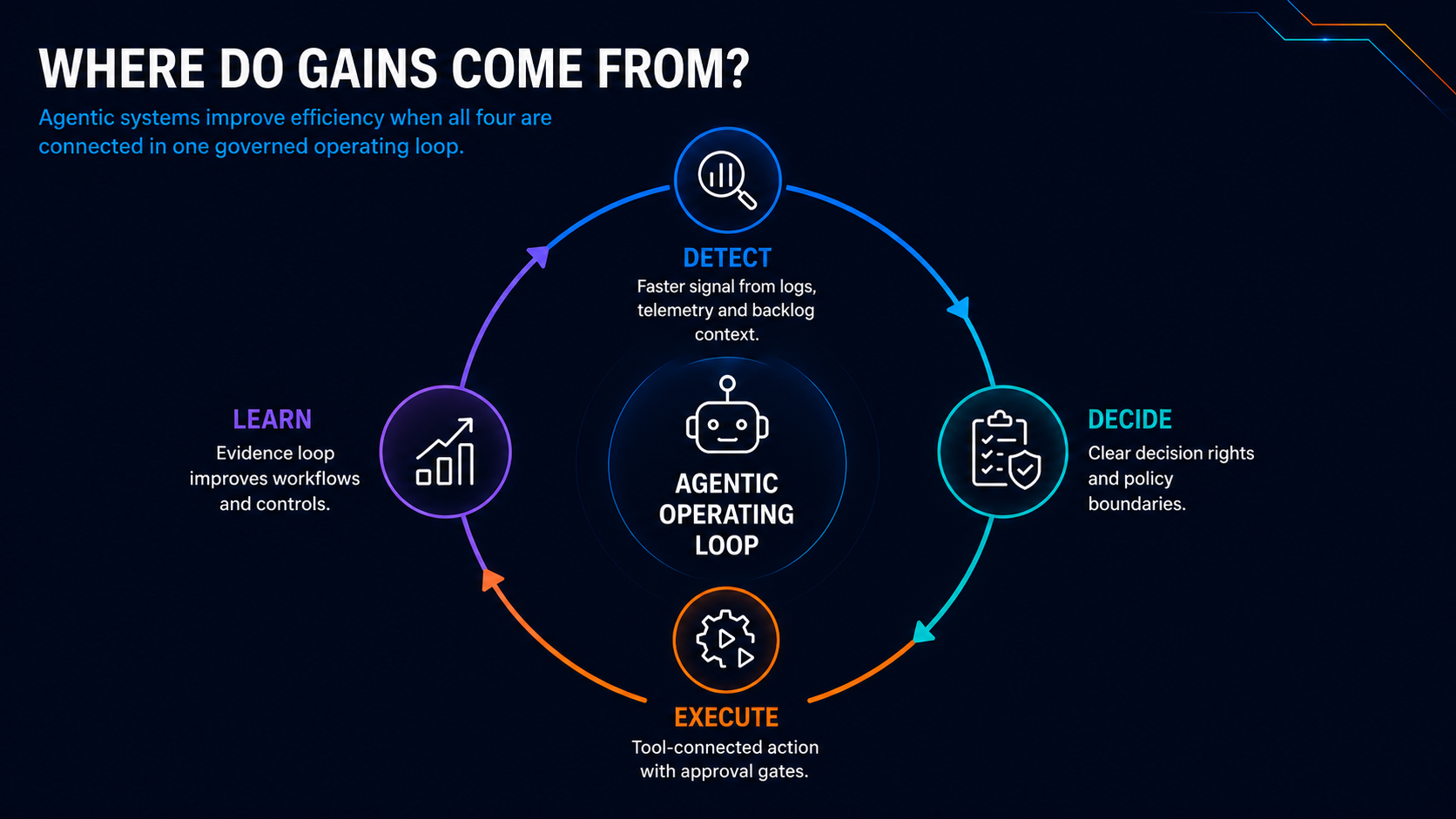
Faster signals from platform, application and AI telemetry need clear decision rights. Decisions need tool-connected execution and every outcome needs to feed an evidence loop that improves the workflow and its controls. Without that loop, AI risks becoming another isolated tool rather than part of the operating model.
Guardrails are what make scale possible
One of the strongest themes of the day was that governance and innovation should be treated as complementary capabilities. Effective governance creates the confidence to innovate faster, while the introduction of greater autonomy makes clear boundaries more important than ever.
Stuart's session outlined a control stack built around identity, policy, execution and evidence. Least-privilege access, scoped credentials, codified decision boundaries, human approval for high-impact actions and auditable action lineage all form part of creating AI systems that can operate safely.
Accountability also remains human.
Product, platform, security, service and on-call leaders all have clearly defined responsibilities when deciding where autonomy can operate and when human intervention is required.
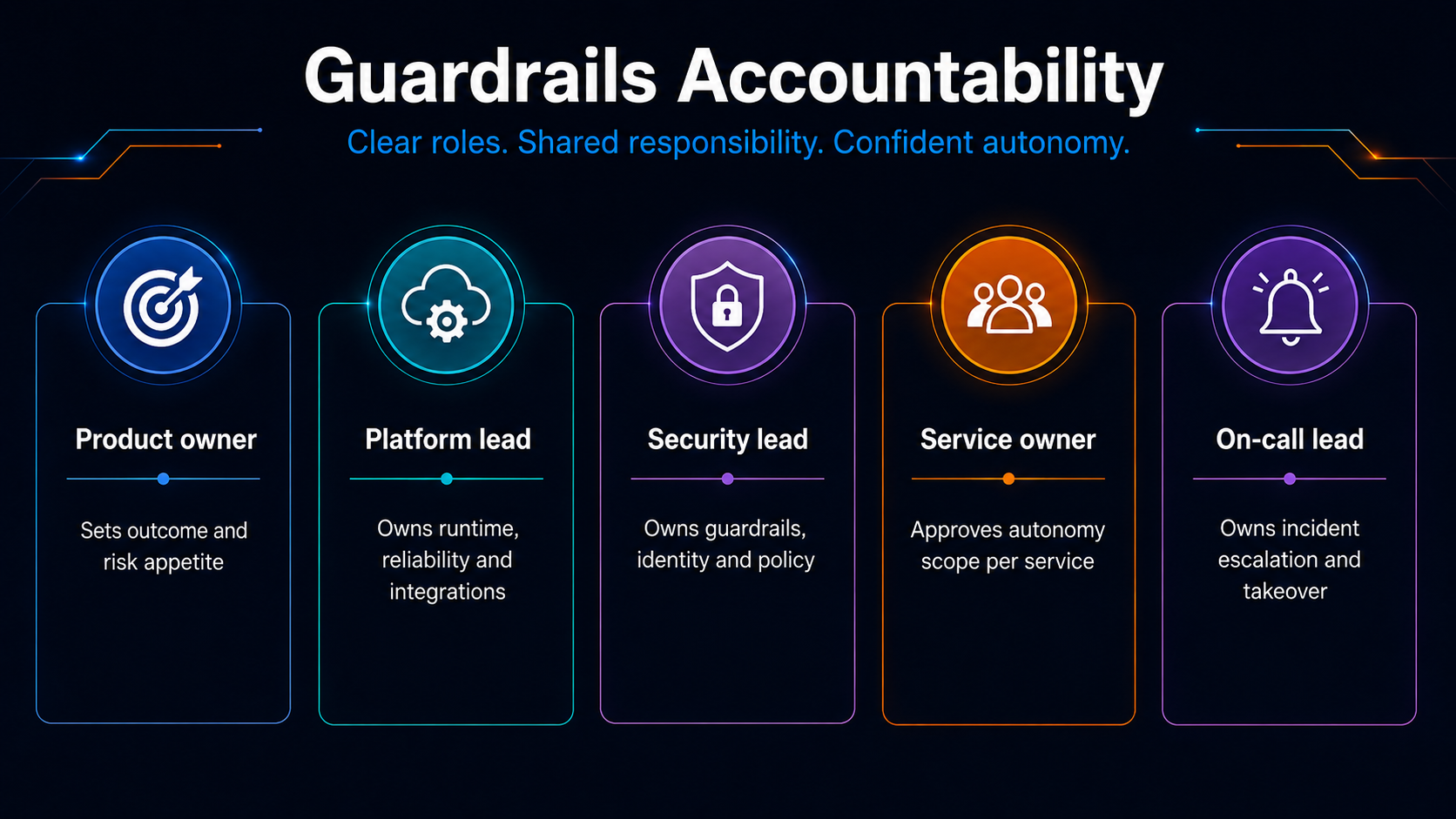
This is particularly important as organisations move from AI assistants towards AI-powered systems capable of taking action. As organisations introduce greater AI autonomy, they need clear boundaries around where agents can operate, who remains accountable for the outcome, and what evidence demonstrates that the system is working as intended.
Before giving an AI agent greater autonomy, organisations should be able to answer three questions:
Under what conditions should the agent be allowed to act?
Who is accountable for the outcome?
And what evidence shows that it is working as intended?
Measure operational outcomes
As AI adoption accelerates, technology leaders will also need to become increasingly disciplined about how they measure its impact. Speed alone is not enough.
If delivery accelerates while change failure rates increase, operational toil remains high or resilience deteriorates, the organisation has not necessarily improved.
The metrics discussed during the day included:
Mean Time to Recovery (MTTR)
Change failure rate
Lead time
Toil share and recovered engineering capacity
Policy violations and control health.
Stuart's framework uses this evidence to make a simple but important decision: scale, hold or adjust. The same principle applies more broadly to AI adoption.
Organisations need to move beyond measuring usage and experimentation and start measuring whether AI is genuinely improving operational and business outcomes.
Start small, build the evidence, then scale
For organisations beginning their agentic AI journey, the advice was to start with a small number of well-defined use cases and build confidence before introducing greater autonomy.
A practical 90-day adoption pathway presented during Stuart's session starts by baselining existing performance and selecting one or two low-risk, high-volume use cases.
From there, organisations can introduce bounded AI assistants with explicit human approval gates before progressing towards multi-agent orchestration within a defined workflow.
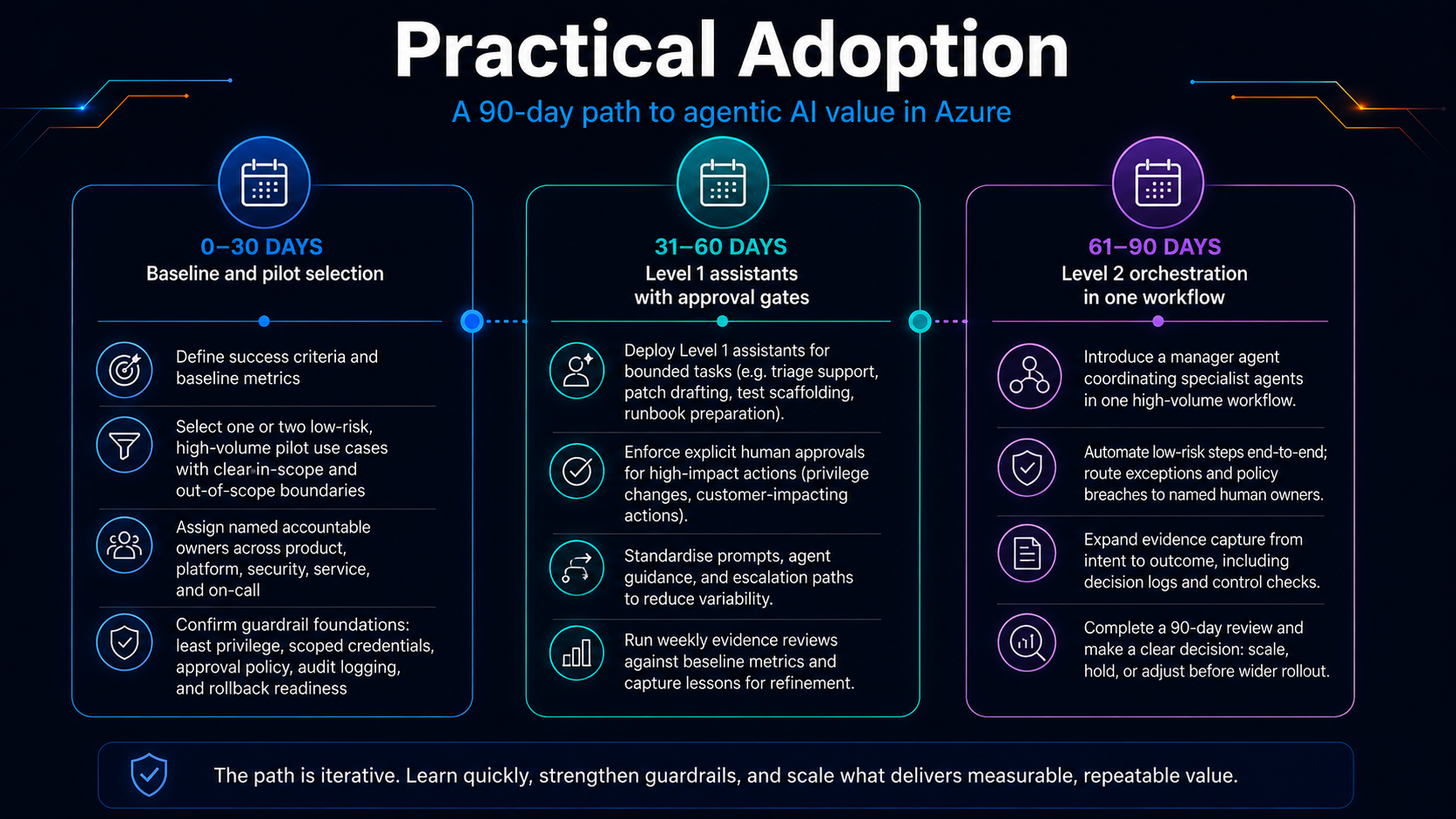
At each stage, evidence is collected, controls are reviewed and the organisation makes a conscious decision about whether to scale, hold or adjust.
This creates a much more sustainable path to AI adoption: one built around measurable progress rather than disconnected experimentation.
Performance under pressure
After a morning of discussion, the afternoon moved from presentations to the track, with guests taking part in the Mercedes-AMG passenger experience and putting their own driving skills to the test in the F1 simulators. The day's agenda deliberately brought the technology sessions and high-performance experiences together at Mercedes-Benz World.

It was a fitting way to close a day focused on performance. More horsepower can create more speed. But without strong foundations, clear controls and the ability to respond to changing conditions, speed alone does not create sustainable performance.
The same is increasingly true for enterprise technology.
AI will give organisations access to extraordinary new capabilities. Real advantage will come from building the platforms, operating models and guardrails that allow those capabilities to be adopted safely, scaled effectively and continuously improved.
At BlakYaks, we believe the real opportunity lies in helping organisations strengthen their Azure foundations, build highly automated cloud-native platforms, and adopt a clear strategy for improving platform maturity over time. By measuring progress at every stage, organisations can introduce AI with greater confidence, control and long-term value.
Ready to move AI beyond experimentation? Get in touch to explore how our AI Foundations Accelerator Pack can help build the foundations for production-ready AI.