How enterprises move AI from individual productivity into core operations
A practical operating model to support the integration of AI into key business processes built on clear ownership, robust Azure foundations and measurable outcomes. Based on themes presented by James Lees, Microsoft Head of Insurance and Investments, at the BlakYaks event ‘Driving Azure performance and scale under pressure’ held at Mercedes-Benz World on 7 July 2026.
Most enterprise AI programmes begin with tools that help employees draft documents, search content, summarise meetings and complete routine tasks faster. Removing some of this administrative workload can improve individual productivity and the employee experience, with potential benefits for job satisfaction and retention.
At an organisational level, however, these gains can be difficult to translate into a material change in operating cost, service quality or capacity, which in turn makes the case for sustained investment harder to demonstrate. Enterprise-wide investment needs to connect AI to a defined business process, an agreed baseline and a measurable change in how that process performs.
Applying AI to a business process starts with understanding where it can make a meaningful difference: reducing manual effort, improving a decision, accelerating a workflow or increasing the capacity of an existing service. Once AI becomes part of that process, the engineering and operational requirements to support it properly increase.
To operate successfully in production, the service requires controlled access to enterprise data, an identity with defined permissions, deployment and change controls, end-to-end monitoring, an accountable owner and a support model. Delivering those capabilities connects the work of business teams, platform engineering, security, data and technology leadership.
Microsoft introduced the concept of the Frontier Firm in its 2025 Work Trend Index to describe organisations embedding AI across employee experience, customer engagement and core operations. A key theme running through James Lees' presentation during the BlakYaks Senior Technology Leaders Event was how the Frontier model must combine human direction with AI assistants and agents as organisations progress towards new ways of working.
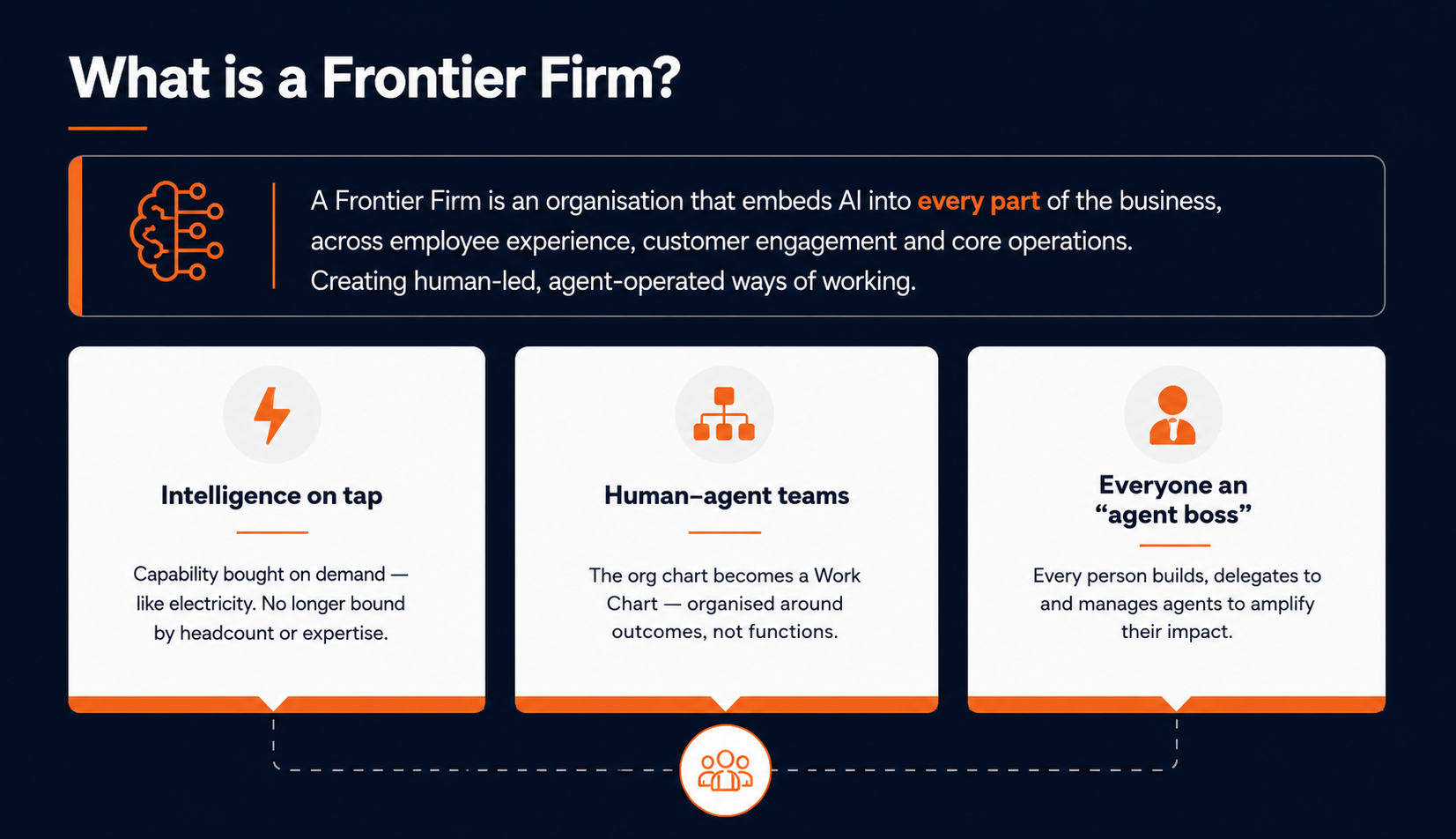
For enterprises, successful adoption requires a repeatable approach to delivery and a way to measure whether AI is improving the performance of the processes where it is deployed.
Moving AI from experimentation into core operations therefore requires organisations to understand which processes are suitable, establish a baseline for their current performance and define the operational or business outcomes they expect AI to improve. As the use of agents and agentic AI increases, the Azure foundations supporting identity, data access, deployment, observability and cost management become increasingly important.
This blog looks at the practical requirements for moving AI into core business processes, from selecting the right use cases, defining measurable outcomes to building the Azure foundations, governance and ownership needed for production use.
Start with a defined business process and the expected outcome
Microsoft 365 Copilot can reduce the time employees spend in routine tasks, such as drafting documents, searching content and summarising meetings. The time saved per team member only becomes important at an organisational level when the business can measure this increased productivity against operating costs, service capacity or customer experience.
James described enterprise AI developing through three operating stages. The first supports personal productivity. The second assigns an agent a defined task within a business process, using approved information and returning an output for review. The third coordinates several agents across a broader workflow, with people retaining responsibility for direction, exceptions and decisions that require judgement.
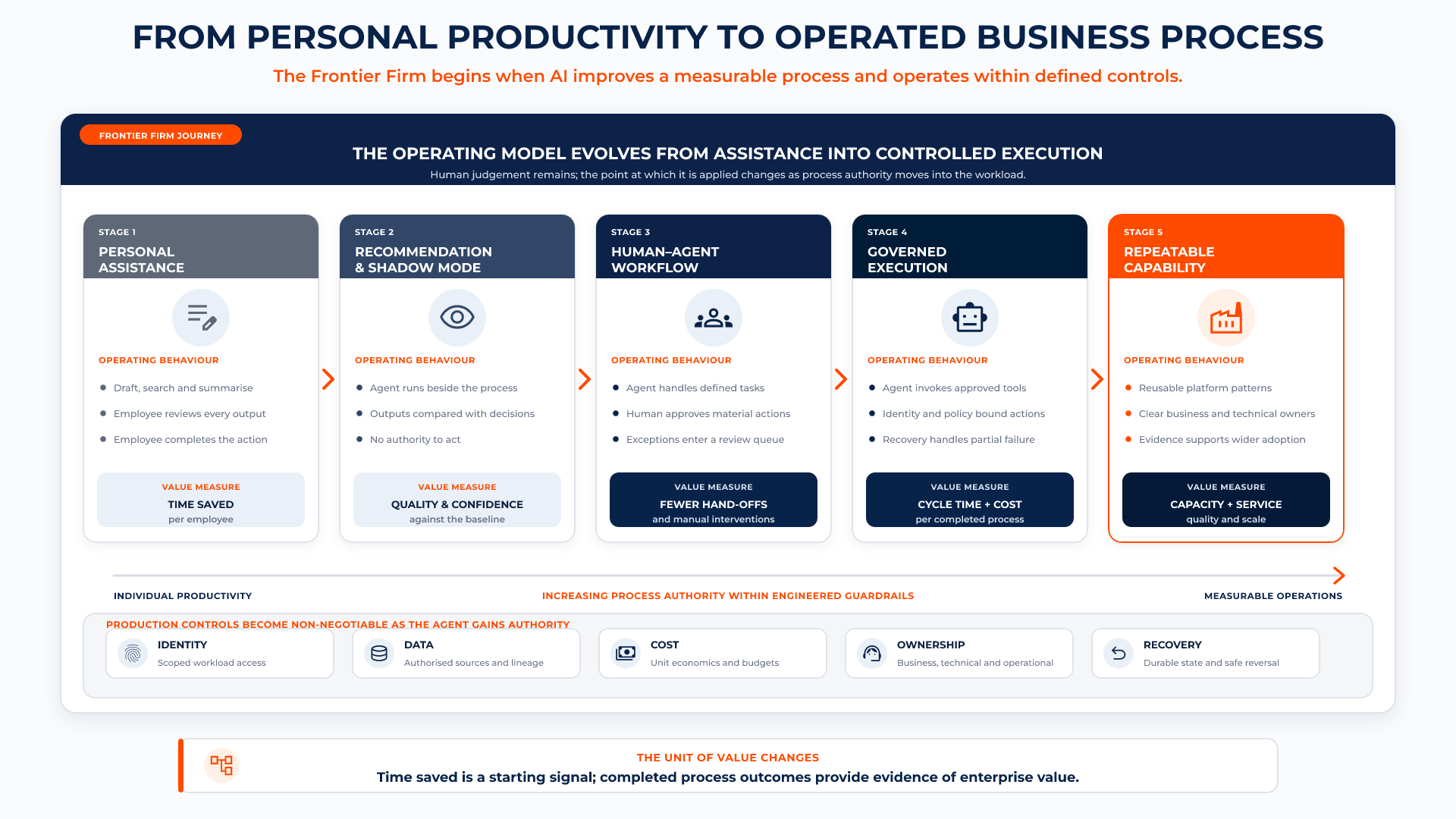
AI creates greater enterprise value as it moves from personal assistance into controlled execution within a measurable business process.
Individual business functions will progress through these stages at different rates because process maturity, data quality and approach to risk varies across the organisation. A stable, high-volume process with known inputs and outcomes provides a stronger basis for automation than work that still depends on informal decisions or inconsistent data. The stage assigned to each use case should reflect the process itself, the consequence of an incorrect action and the organisation's ability to operate it.
Microsoft describes itself as “customer zero” for AI, using its own operations to test how AI can be applied at enterprise scale. James cited Microsoft’s contact-centre operations as one example of this approach. Microsoft reported more than $500 million in savings over one year, alongside an increase in customer satisfaction. By applying AI to a high-volume, customer-facing process with an established cost base and measurable service outcomes, Microsoft was able to demonstrate the impact of production AI through improvements in both service cost and customer experience.
Business teams define the process and the outcome
Employees who carry out a regular business process understand where their work is delayed, which information is difficult to assemble and those decisions that rely on experience. Their involvement is needed to describe the current process accurately, identify an appropriate role for AI and establish where human review remains necessary. Technology teams can then assess whether the proposed service can be deployed and operated within the existing enterprise environment.
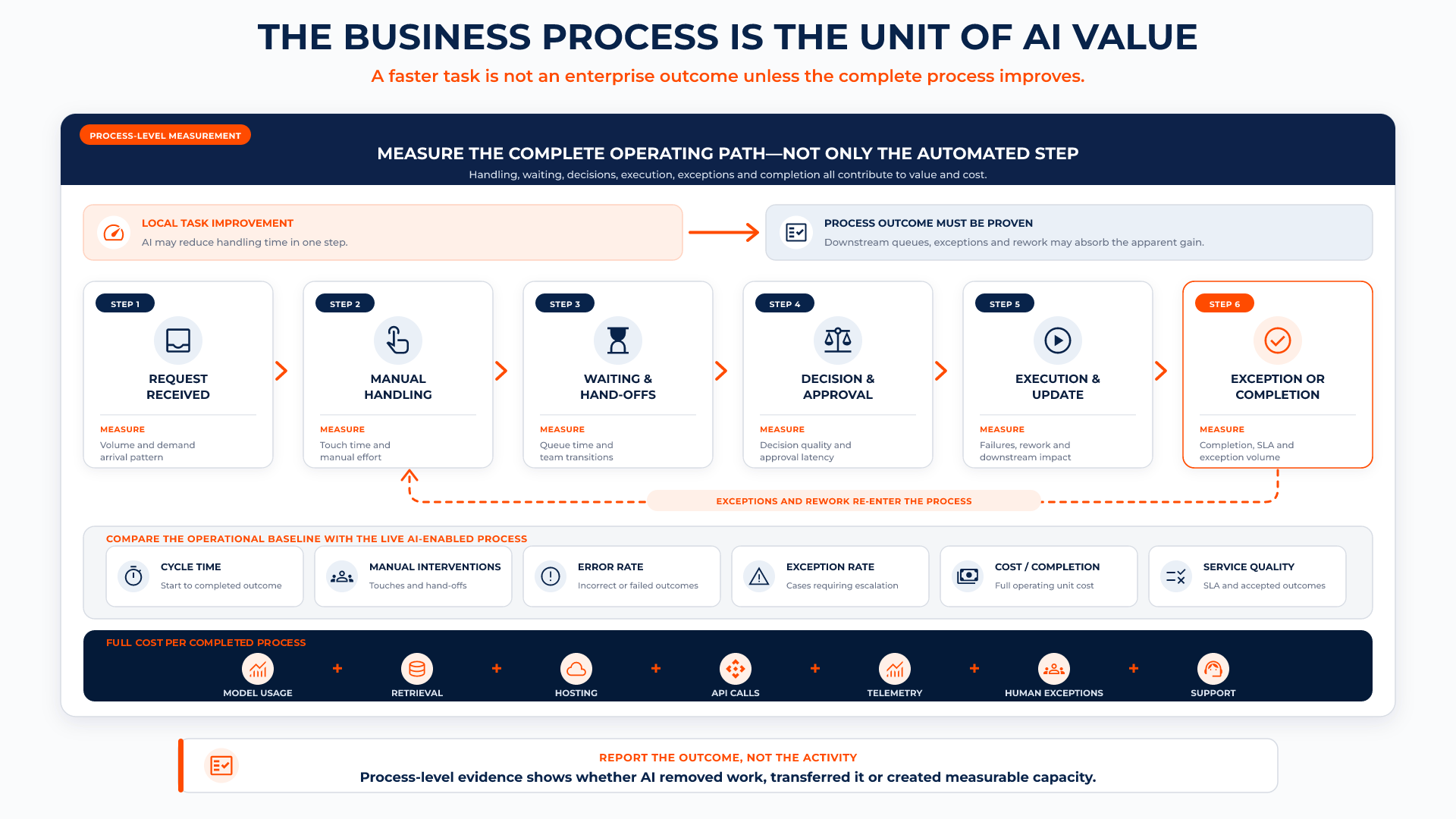
AI value should be measured across the complete business process, including hand-offs, exceptions, human intervention, cost and service outcomes.
A well-defined use case captures the process owner, trigger, inputs, systems involved, expected output, decision points, exception routes and success measures. It also identifies the information the service may access and the actions it may take. This definition allows platform, security and data teams to design permissions and controls against a real operating requirement.
Adoption should be designed around the same process. General training explains how a tool functions; role-based guidance explains which information employees may use, how outputs should be checked and when a decision must remain with a person. Involving process owners and employees in these decisions gives them visibility (and understanding) of how their work will change and which knowledge they remain responsible for applying.
The same 2025 Work Trend Index also found that leaders at Frontier Firms were less worried about jobs being replaced by AI than leaders globally. The finding is consistent with an operating approach in which people understand the technology, participate in its application and retain clear responsibilities within human-agent workflows.
Process-level AI consumes the full Azure platform
An AI service that underpins a business process demands the same controls as other production workloads. It needs an approved subscription and network architecture, controlled identities, secure access to data and API integration, a repeatable automated deployment path, policy enforcement, monitoring, and recovery arrangements. Model selection forms part of this wider service architecture, alongside the platform capabilities required to deploy and operate the service reliably.
An established Azure Landing Zone provides management-group structure, subscription governance, networking and policy. Azure DevOps or GitHub pipelines provide a controlled route for deploying the workload and its dependencies. Infrastructure as Code records the intended configuration for development, test and production, allowing teams to review changes, detect drift and rebuild the service without relying on undocumented manual deployments.
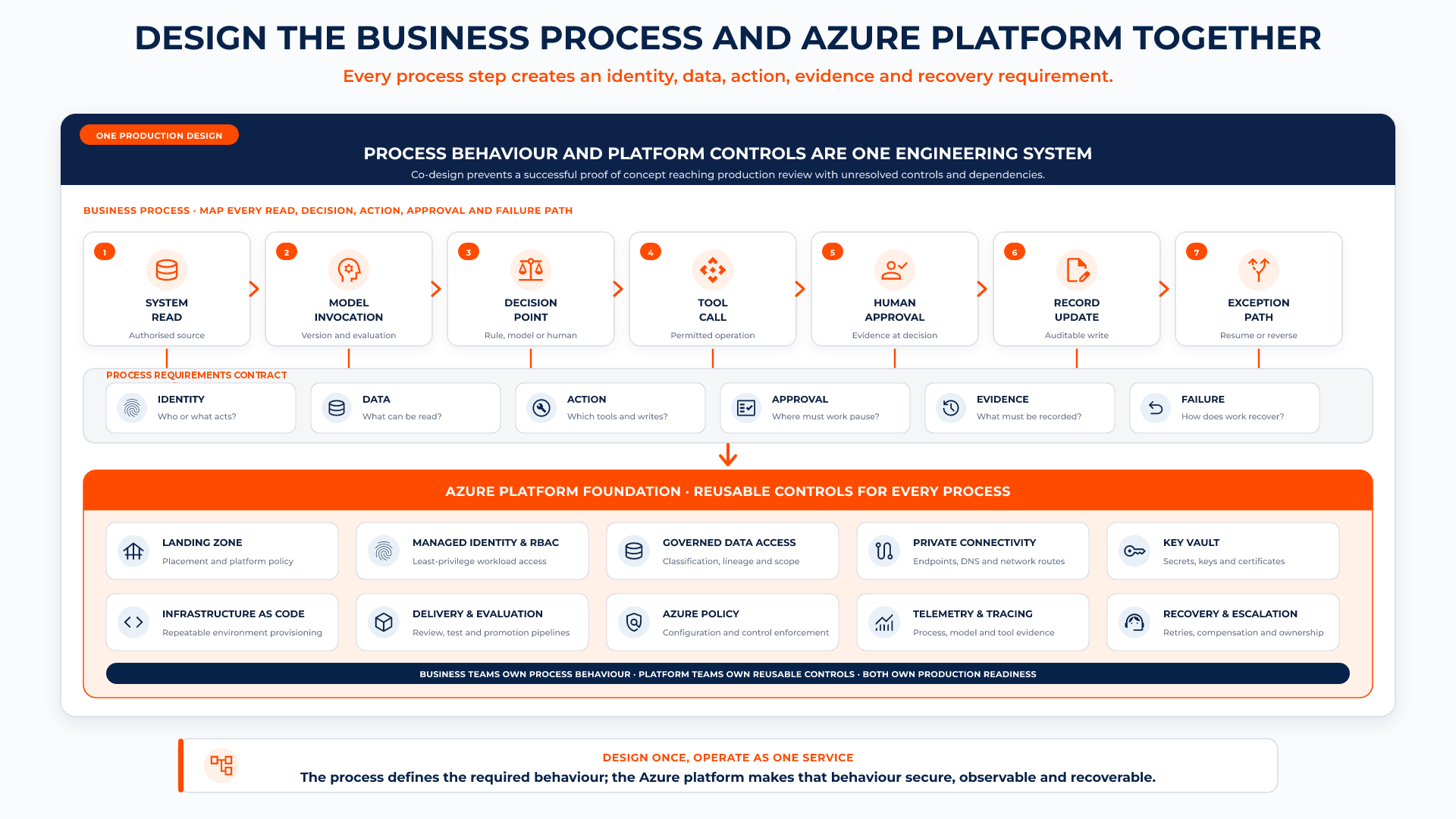
Designing the process and platform together ensures that every AI action is supported by the appropriate identity, data, security, evidence and recovery controls.
Identity defines the effective authority of an agent. Managed identities and least-privilege role assignments restrict the data, APIs and tools it can use. Private connectivity and approved integration patterns provide secure access to enterprise data and internal services while keeping that access within the organisation's network and data-governance model.
Operational visibility needs to encompass the complete end-to-end workflow. Platform teams require telemetry for requests, model and prompt versions, tool calls, data dependencies, latency, failures, human approvals and consumption. Azure Monitor and the wider observability platform should aggregate this evidence so support teams can identify whether a failure sits in orchestration, identity, networking, data access, a model endpoint or a downstream system.
At BlakYaks, we treat these capabilities as part of the “Azure platform product”. Organisations with established landing zones, pipelines and reusable Infrastructure as Code modules can add AI foundations to their existing operating model. New AI use cases can then consume these platform capabilities, avoiding the need for isolated environments with their own connectivity, access and monitoring decisions.
Agents require production ownership and control
An agent becomes a production workload when a team or business process depends on its output or actions. The service inventory should record its purpose, business and technical ownership, users, identities, data sources, connected tools, deployment environment, support tier, cost owner and review date. Having this clearly defined and documented ensures that the organisation retains control.
Permissions should reflect the task assigned to the agent. An agent that retrieves information needs read access to specific sources; an agent that updates a system of record carries a different level of operational risk. High-impact actions may require human approval, separation of duties or transaction limits. Access reviews and recertification confirm that permissions remain appropriate as the process and data estate change.
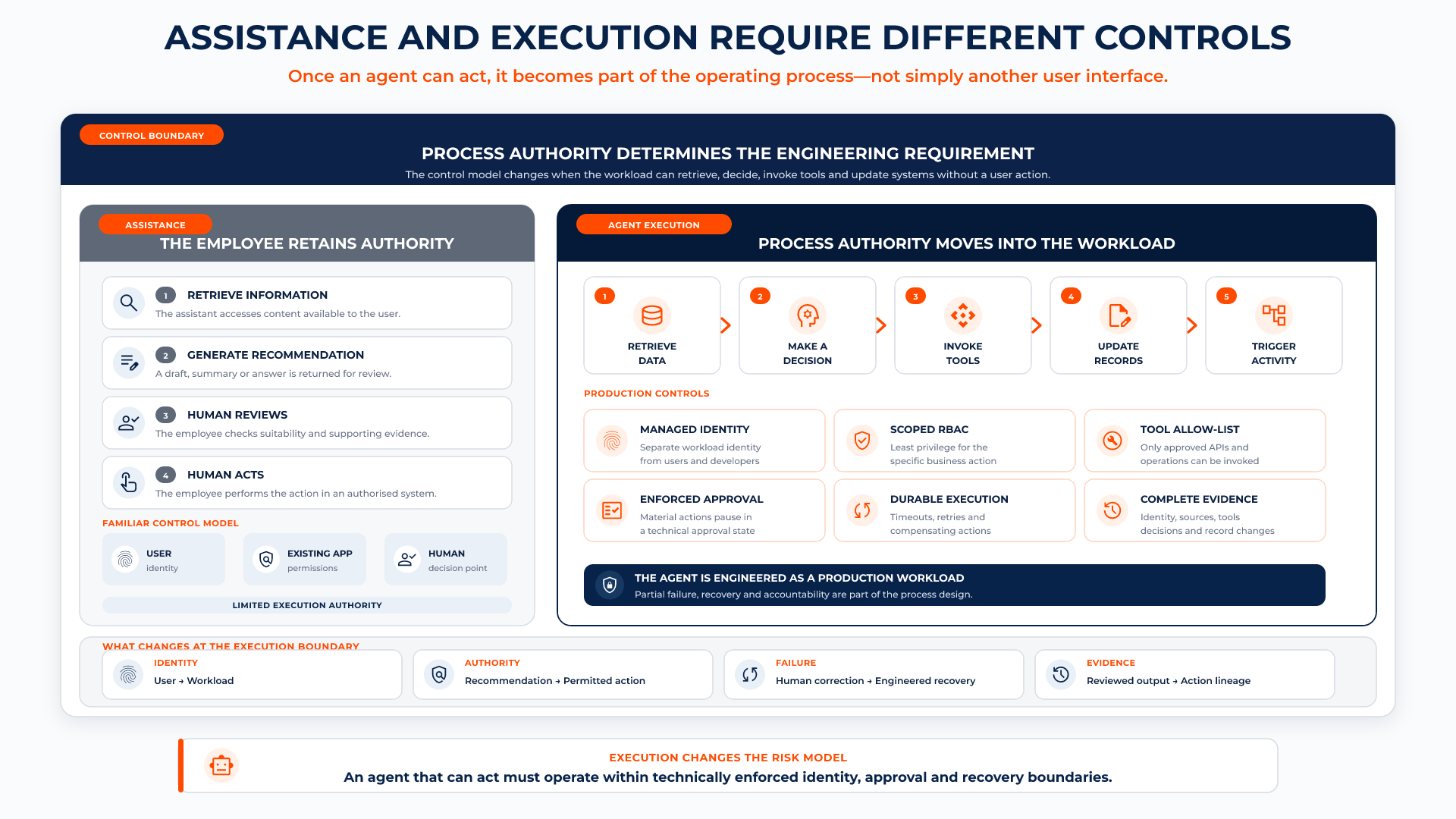
As authority moves from the employee to the agent, technically enforced identity, permissions, approvals, evidence and recovery controls become essential.
Technical availability provides one measure of service health. Cost per completed process, exception rates, rejected outputs, human rework and downstream failures show whether the service remains economically and operationally suitable. Azure consumption budgets (inc AI services) and attribution should therefore be designed alongside reliability and security controls.
Regulated organisations also need evidence that reflects the live service. Source-controlled configuration, pipeline records, policy-compliance data, identity logs and operational telemetry show how the service was deployed, what it can access and how its behaviour has changed. This evidence supports security, risk and audit teams with current information instead of relying solely on documents produced during the original deployment.
A shared operating model connects strategy, delivery and ownership
Technology leadership sets the investment priorities, risk position and engineering standards for enterprise AI. Business leaders select processes, define the expected outcome and accept accountability for the resulting service. Platform engineering provides reusable Azure patterns, while security, data and risk teams define the boundaries for identity, information use and operational evidence.
James emphasised that employee-led AI use-case discovery needs to align with the organisation’s delivery model and wider enterprise direction. Executive sponsorship establishes the priorities and resources, while process owners and employees contribute the operating knowledge needed to design useful services. The platform team then translates those requirements into approved architectures and repeatable deployment paths.
A cross-functional Centre of Excellence (CoE) can only coordinate these responsibilities effectively if empowered to make delivery decisions. Its remit should cover use-case prioritisation, approved architecture patterns, risk classification, ownership, production acceptance, and value measurement. Communities of practice and champions can support adoption, while the CoE maintains the standards that protect the wider technology estate.
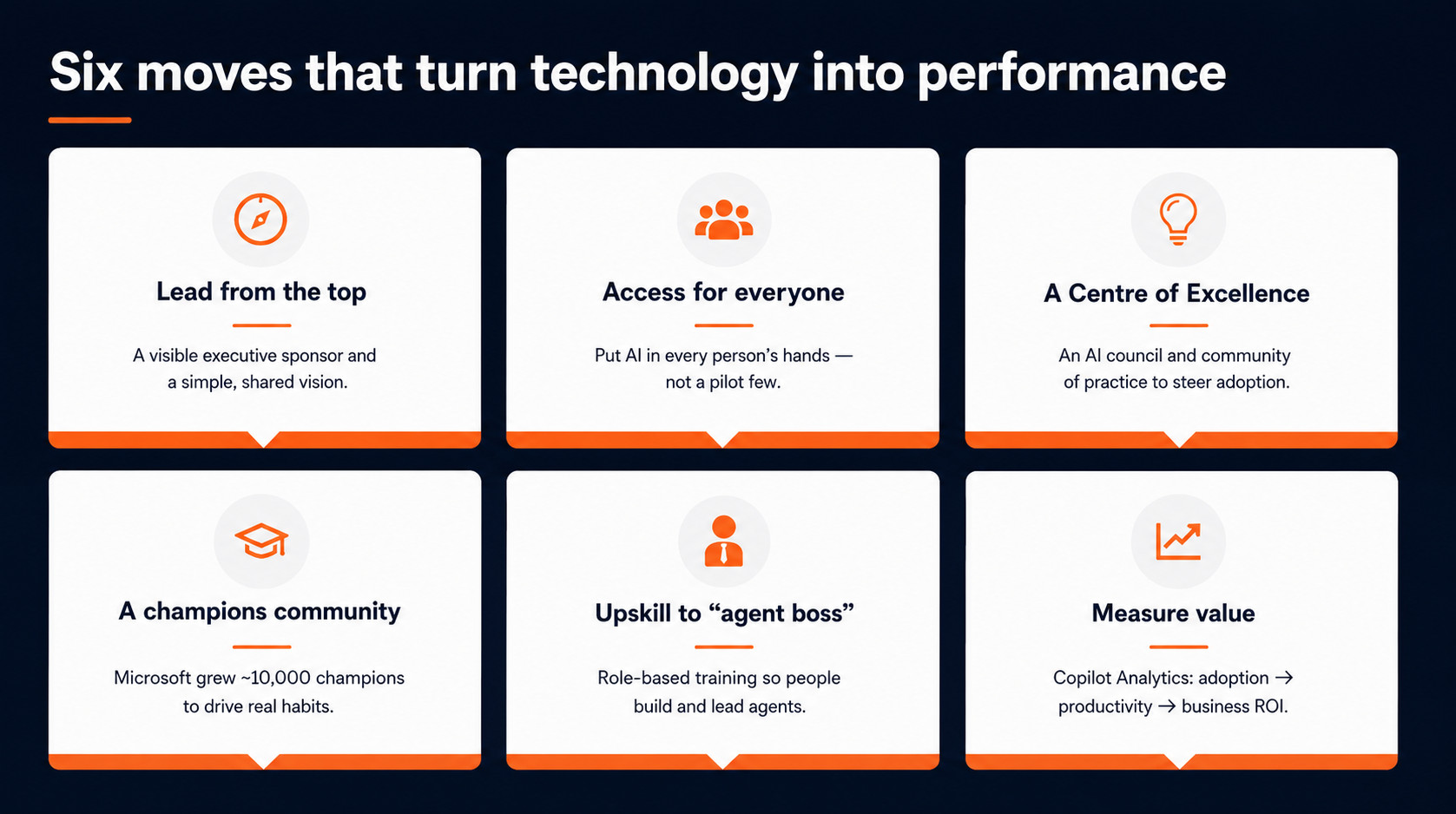
Governed self-service gives employees access to approved AI capabilities through role-based permissions, reusable components and supported deployment patterns. Platform teams retain control of the underlying architecture and policy while business teams develop applications within defined boundaries. Usage, cost, service performance and process outcomes then provide evidence for deciding which services should continue, change or be retired.
Questions for senior technology leaders
Before approving wider AI adoption, leadership teams should be able to answer the following questions using evidence from the process, platform and operating model:
Which measurable process problem could AI improve?
Where does assistance end, execution begin and human approval remain necessary?
Which Azure platform capabilities can be reused across the next set of use cases?
Who will operate, support, review and retire each agent after its initial creator steps away?
How will cost, quality, exceptions, human rework and customer or employee outcomes be measured?
Which thresholds will determine whether the use case expands, changes or stops?
Can security, risk and audit teams inspect current deployment and operational evidence?
From individual use to an enterprise operating capability
Enterprise AI adoption becomes sustainable when organisations define the process before automating it, connect investment to measurable operating outcomes and deploy services through reusable controls.
Process owners retain responsibility for the result, while platform, security, data and operations teams provide the engineering conditions required to run the service safely.
This operating model gives leadership a consistent basis for selecting AI use cases, controlling risk and assessing value. It also gives employees a practical role in shaping how AI is applied to their work.
The combination supports a sustained portfolio of AI services within your existing operating model, promoting simplification and standardisation.
If your AI use cases are being constrained by one-off infrastructure, identity and governance decisions, speak to BlakYaks about building the Azure foundations needed to move AI into production and scale adoption with confidence.
Or learn more about our AI Foundations Accelerator Pack and how it helps establish those foundations.