
Models don’t transform organisations, platforms do.
Summary: Why Azure platform engineering determines whether AI becomes an enterprise capability? AI pilots are now moving into day-to-day operations. At that point, success depends less on model choice and more on platform readiness. This blog explains why delivery speed, security and control come from strong Azure foundations, and how identity, networking, governance, Infrastructure as Code, automation and observability help organisations scale AI safely.
Most organisations can now access powerful AI models quickly through Microsoft Foundry, Azure OpenAI, Microsoft 365 Copilot and many other options. The challenge is that model access alone does not deliver production outcomes. When AI supports a critical or regulated process, it still relies on Azure for identity, connectivity, deployment, governance, monitoring and recovery.
Choosing a model and proving a use case is just the first step. What matters next is whether teams inherit a clear route into production or have to build one themselves. In a mature Azure platform, subscriptions, managed identities, private connectivity, policy controls and observability are standard. In a fragmented platform, those basics are redesigned for each workload, which slows delivery and increases operational risk.
AI does not create platform problems, but it exposes them quickly. Differences in subscription design, private DNS, IaC modules and change processes might be manageable at low volume. As AI use cases increase, those differences create repeated design, review, deployment and support work. Occasional exceptions become a permanent drag on delivery.
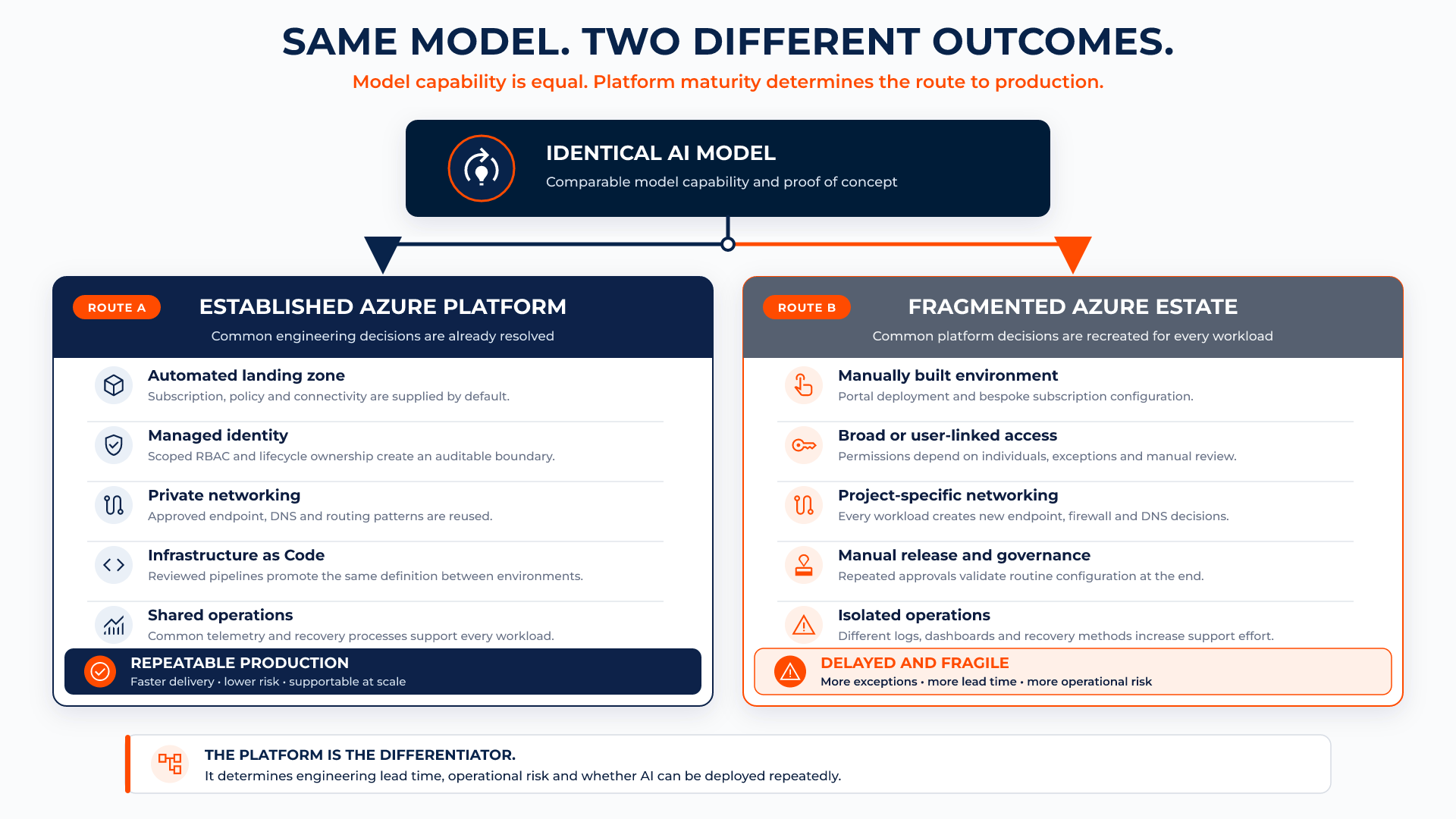
Platform maturity determines whether the same AI model becomes a repeatable production service or another operational exception.
James Lees, Head of Insurance & Investments at Microsoft, summarised the underlying constraint during his Frontier Firm session at BlakYaks' “Driving Azure Performance and Scale Under Pressure” event at Mercedes-Benz World on 7th July: ‘Models don't transform organisations. Platforms do’. Model capability becomes enterprise capability only when the surrounding platform can deploy and operate it consistently.
At BlakYaks, we treat enterprise AI adoption as a platform engineering challenge. Our goal is to run AI workloads through the same core capabilities as other production services, adding extra controls only where needed. This keeps operations consistent and ensures platform investment continues to deliver value as models and services evolve.
AI exposes underlying platform problems
Most enterprise Azure estates have evolved over several design cycles. A landing zone may have been expanded for migration, changed for another business unit and adapted again after acquisition. Workloads still run, but moving from development to production becomes harder as management groups, networks, policies and tooling drift apart.
AI programmes hit this variation early. Each workload depends on several platform services and must move cleanly through development, test and production. When networking, identity, policy or service settings differ between environments, releases stop being repeatable. A typical AI app may depend on Microsoft Foundry, Azure OpenAI, Azure AI Search, Storage, Key Vault, private connectivity and internal APIs. If those layers are inconsistent, teams end up handling avoidable exceptions.
Proofs of concept can hide this complexity because they do not need full production controls. Teams may use broad permissions, public endpoints, local credentials and manual setup to prove value quickly. In production, those shortcuts are not acceptable. Delays often blamed on AI governance are usually unresolved platform decisions appearing at release time.
The Azure platform determines delivery speed
Delivery speed depends on platform maturity, governed self-service and automation. When teams can request subscriptions through standard processes, use approved network patterns and deploy from maintained Bicep or Terraform modules, they begin with known controls. Security teams can then focus on the use case and data, rather than re-checking basic platform setup every time.
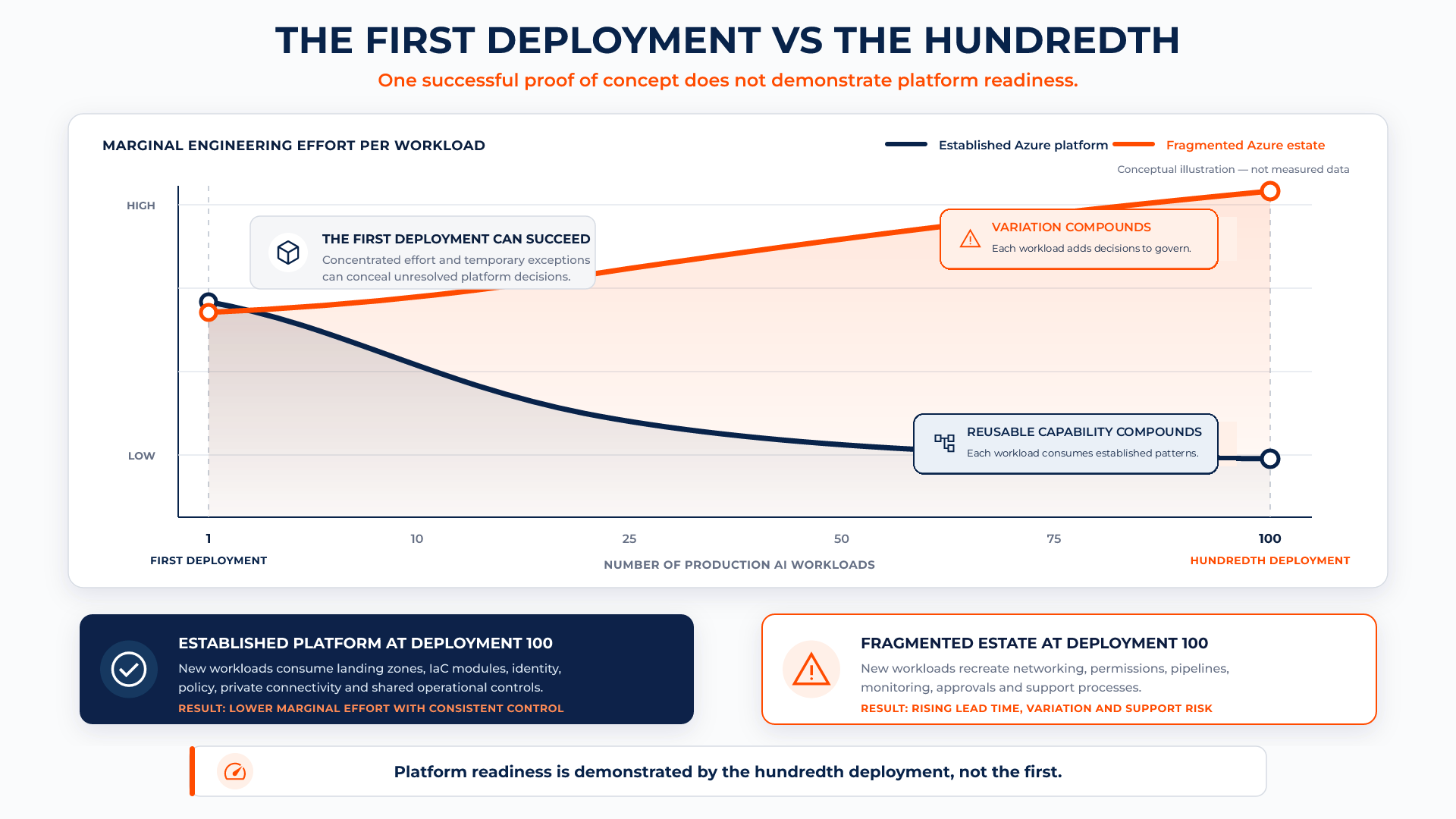
Reusable platform capabilities reduce the effort required for each new workload, while fragmented foundations compound complexity.
In fragmented estates, teams solve the same platform issues repeatedly. They negotiate IP ranges, request firewall changes, align DNS, redesign monitoring, revisit role assignments and build new pipelines. Each choice may make sense in isolation, but together they increase variation. Delivery effort rises because common capabilities are rebuilt instead of reused.
A first AI deployment is not proof of platform readiness. It can succeed through extra effort and temporary exceptions. The true test comes later, when many services must be delivered quickly and safely. Mature platforms reduce effort per workload while keeping controls consistent.
Production AI depends on the full platform
AI services should enter production as governed workloads, not separate environments outside normal controls. Their resources should sit in the right landing zone, their identities should be managed over time, and their dependencies should follow standard network, policy, change and support practices. The model endpoint is only one part of the wider service.
Identity design becomes critical when agents or orchestrated workflows access multiple systems. Reusing developer accounts or over-privileged service principals makes ownership unclear and governance harder, often at significant risk. Workload-specific managed identities, scoped Azure RBAC and controlled API access create a clear, auditable boundary.
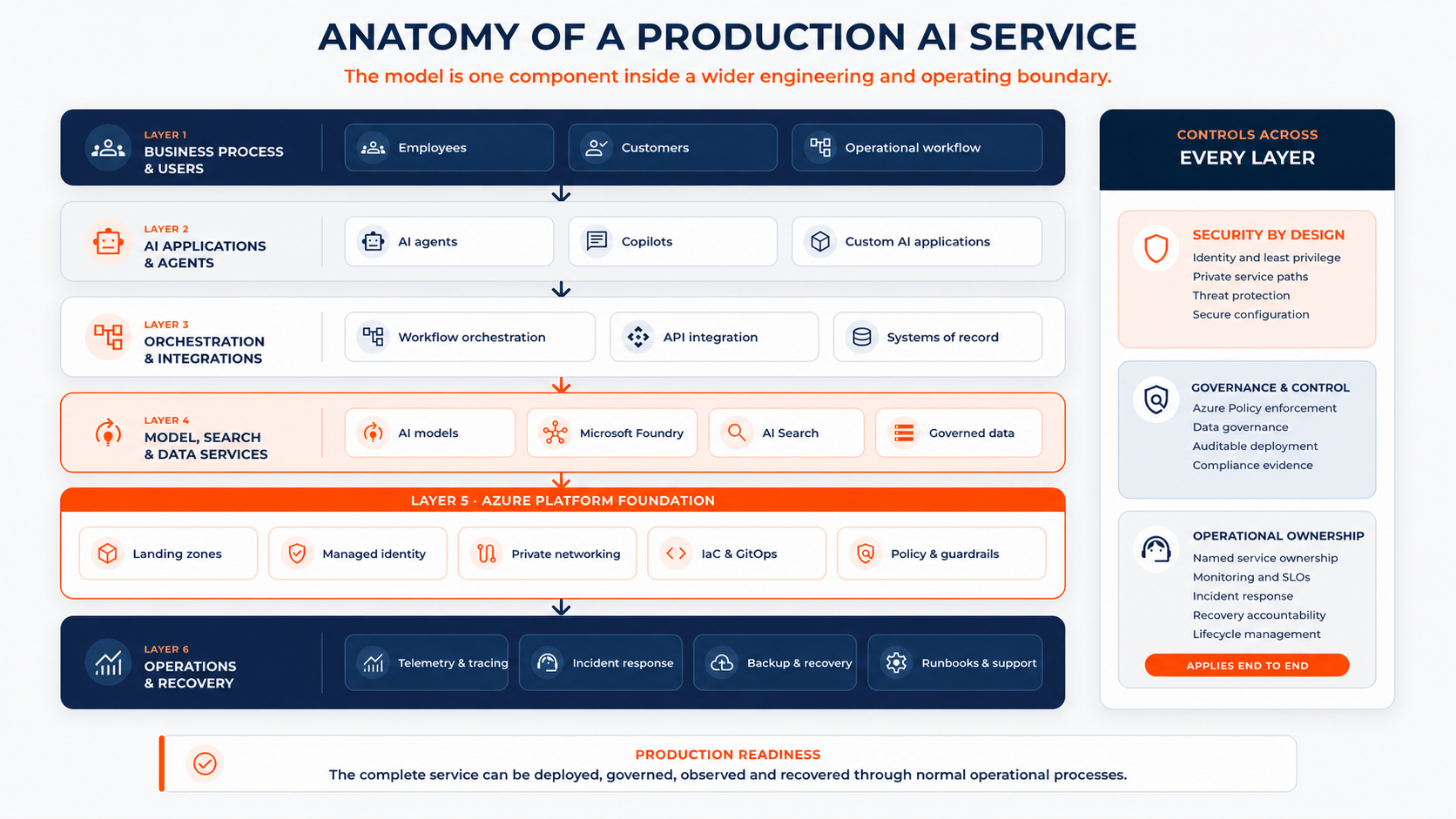
Production AI depends on the complete service surrounding the model, from business processes and integrations to governance and recovery.
Private connectivity also needs a standard pattern. Disabling public access on Microsoft Foundry, Azure OpenAI, Azure AI Search, Storage or Key Vault is only the starting point. Private endpoints, subnet capacity, security controls, routing and DNS all need to work together. Without a shared pattern, small design differences can cause expensive and hard-to-diagnose failures.
Azure Policy should enforce core controls across all workloads, including allowed regions, diagnostics, network exposure, tagging and approved configuration. Teams still need architectural judgement for workload-specific risk, but routine compliance should be automatic. Policy guardrails provide early feedback and stop known defects from reaching production.
Infrastructure as Code turns speed into controlled change
AI-assisted development can increase output across code, IaC and pipelines. Production confidence still depends on a reliable path from source control to Azure. Peer review, risk-based engineering review, static analysis, security scanning, preview checks, policy evaluation and controlled promotion remain essential.
Infrastructure as Code does more than repeat provisioning. It captures intended state, links change to reviewed commits and allows environments to be rebuilt without relying on portal history. GitOps extends this by making source control authoritative for platform and workload configuration, so drift is visible and can be corrected before it becomes an incident.
Manual governance cannot keep pace with high delivery frequency. More meetings, tickets and approvals add overhead but do not solve structural issues. Encoding standard decisions in reusable modules, pipelines and Azure Policy applies controls consistently and frees platform teams to focus on real exceptions.
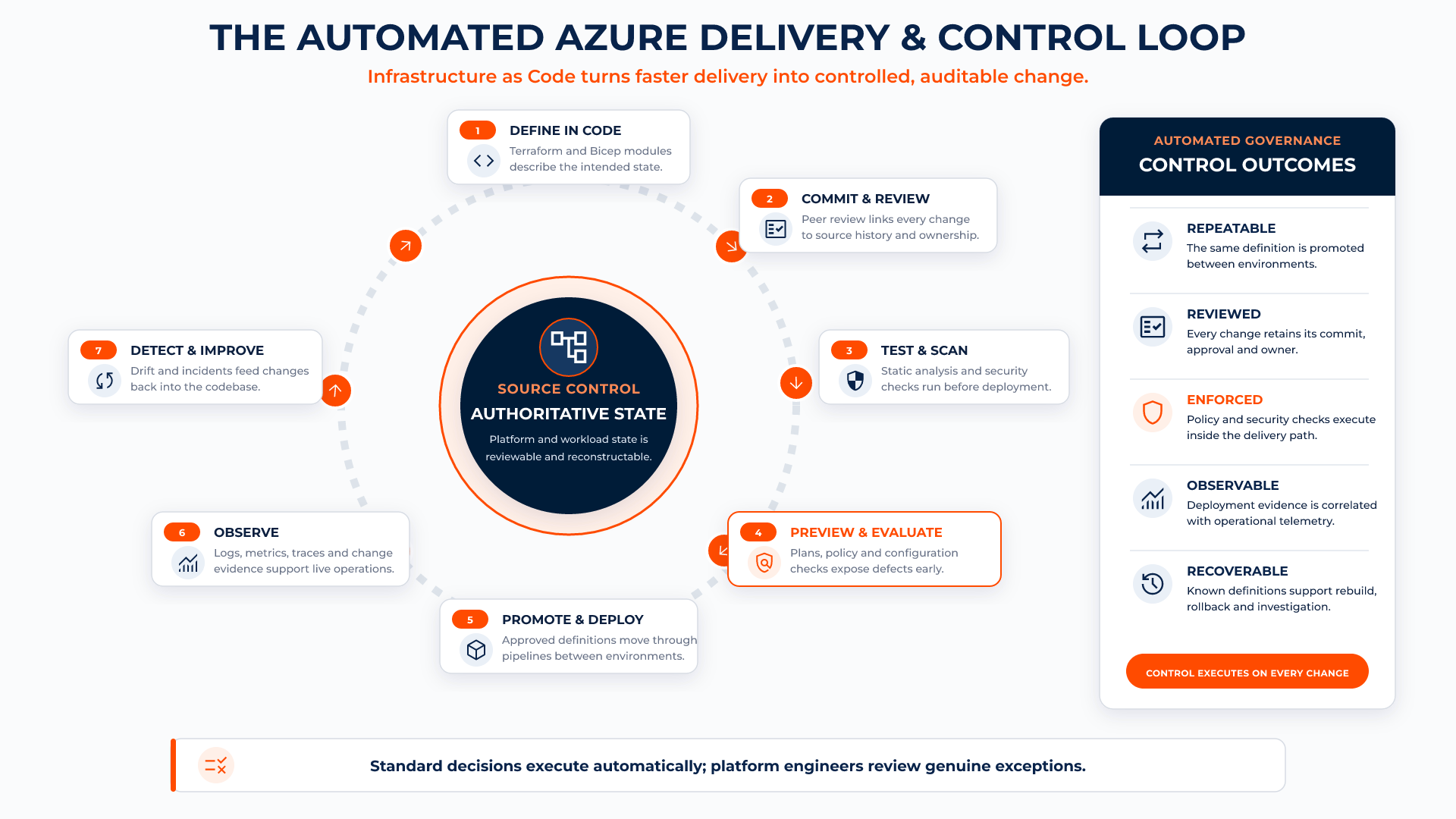
Infrastructure as Code and automated controls make every platform change repeatable, reviewable and auditable.
Observability and recovery decide whether AI is truly operable
Production AI fails in ways that go beyond the model. A healthy deployment cannot compensate for lost identity access, DNS issues, unavailable search indexes or partial downstream transactions. Teams need joined-up telemetry across infrastructure, applications, identity, model activity, dependencies and deployment history.
Monitoring should ship with the workload, not be added later. Shared Azure Monitor, Log Analytics and Application Insights patterns give support teams the context they need quickly. Common correlation IDs, diagnostics and retention settings make it easier to separate platform faults from orchestration, data or model issues.
Recovery design must cover all dependencies and state around the model. Timeouts, retries, idempotent operations, circuit breakers, approval points and fallback behaviour should match business processes. Infrastructure as Code should rebuild resources from known sources, and runbooks should define how partial work is resumed or rolled back. An AI workload is production-ready only when operations teams can diagnose and recover it in normal conditions.
Platform investments outlast models
Model selection still matters because capability, latency, context, data handling and cost influence design. But model choices change faster than platform foundations. Management groups, landing zones, identity boundaries, network architecture, deployment pipelines, policy and observability can support the organisation for years.
A platform built on durable interfaces keeps model and service changes local to each workload. Teams can test new models or capabilities without redesigning governance, networking or release processes. Where every AI project builds its own foundations, each technology change creates more variation and support overhead.
The strongest return from AI platform investment comes from reducing effort for each new capability. Standard modules, approved architectures and automated controls improve security, resilience and delivery across both AI and non-AI services. They also reduce dependence on any single model provider or framework.
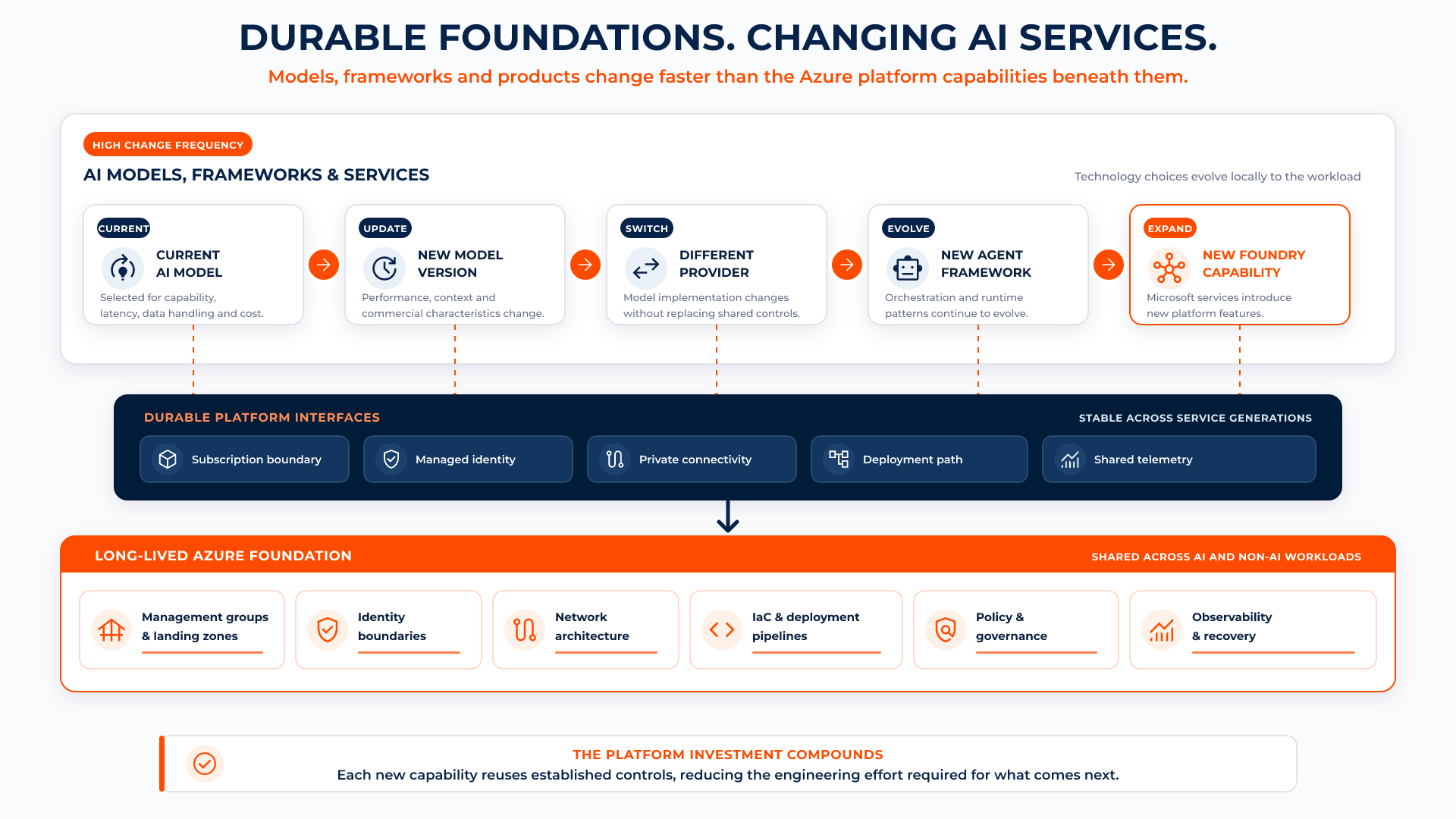
Stable Azure foundations allow models, frameworks and services to evolve without rebuilding common controls for every workload.
Applying this approach with pre-engineered Azure foundations
BlakYaks' AI Foundations Accelerator Pack brings together the capabilities that appear repeatedly in enterprise AI delivery: governed Azure environments, Infrastructure as Code, identity integration, private connectivity, deployment pipelines, policy controls and operational telemetry. It provides a controlled starting point that can be adapted to each organisation’s landing zone, security requirements and delivery model.
Pre-engineering reduces repeated design and implementation effort, but it does not remove the need to understand the existing estate. Identity boundaries, data classification, connectivity, operational ownership and recovery objectives still require architectural decisions. The Accelerator applies proven patterns consistently, reducing the vast majority of repeated design decisions for common Azure components in each AI use case.
This approach helps AI programmes scale within an enterprise platform roadmap. Improvements made for early workloads strengthen the shared Azure capability used by later teams, and as demand grows, new services can be absorbed through established controls instead of creating technical debt.
Questions for senior technology leaders
These questions test whether an Azure estate can turn model capability into repeatable production services:
Can a new AI workload use the existing landing zone, identity model, private connectivity pattern and deployment pipeline without exceptions?
Does Infrastructure as Code define the production environment clearly enough for engineers to recreate it and explain every material change?
Are common security and governance requirements enforced through Azure Policy and pipeline controls, or still checked manually during release?
Can operational telemetry trace a request across models, data services, identities, network dependencies and downstream APIs?
Would ten new AI workloads create ten consumers of shared capabilities, or ten new infrastructure and support patterns?
Can the platform adopt another model or Microsoft Foundry capability without redesigning governance, networking and operational ownership?
Build for continuous adoption
Enterprise AI becomes repeatable when engineering and design decisions are applied consistently. Landing zones define boundaries, managed identities control access, private networking protects service paths, Infrastructure as Code makes delivery predictable, policy enforces standards, and observability provides operational evidence. Together, these capabilities shorten the path from a promising use case to a supportable production workload.
Models will improve and product names will change. Organisations with strong Azure foundations can adopt those changes through an established operating model, while fragmented estates continue to lose capacity resolving infrastructure differences. The platform decides whether each new AI workload extends enterprise capability or creates another exception.
BlakYaks helps organisations build the Azure foundations needed to take AI workloads into production safely and repeatedly. Our engineers combine landing zones, managed identities, private connectivity, Infrastructure as Code, GitOps, Azure Policy and observability into a consistent operating model.
The BlakYaks AI Foundations Accelerator Pack provides these capabilities as pre-engineered components, reducing delivery effort and risk for each additional workload. If AI pilots are working but production still depends on one-off infrastructure decisions, get in touch with our team.